
Back-to-School Puppy Tips: Keep Training on Track
Quick answer: To help your new puppy handle the quiet house once school starts, keep a steady routine of potty breaks, crate or playpen time, and short training sessions. Plan for safe company in the middle of the day, like a trusted dog walker, so your puppy is not alone too long. That helps you avoid accidents, chewing, and backsliding on training. If you brought home a summer puppy in Fairfield County, back-to-school season can knock your puppy training off track fast. The house goes from busy and noisy to quiet and empty, and your puppy suddenly has to handle long stretches alone. With a simple plan for potty breaks, structure, and support, you can keep your puppy’s training moving forward instead of watching it slide backwards. In this guide, I will walk you through what really matters for your puppy this fall, how to adjust your routine, and how regular midday dog walking memberships in places like Fairfield, Stratford, Westport, Easton, Southport, Black Rock, and Bridgeport can make the school-year transition smooth for everyone. 🐾 🐾 🐾 🐾 🐾 🐾 🐾 🐾
The summer puppy meets September: what actually changes?

The biggest change is simple. Your puppy goes from having company most of the day to being alone for long blocks of time. That shift hits hard around 10 to 16 weeks of age, right when you should be building steadier habits.
All summer your kids are home. You are in and out of the kitchen. Someone is always walking through the living room. Your puppy naps, plays, goes outside often, and gets tons of casual attention. Then one Monday in September, everyone walks out the door at 7:30 a.m. and the house in Fairfield or Stratford suddenly feels like a ghost town.
From your puppy’s point of view, that's confusing. One day, constant company. The next, silence for six or seven hours. Puppies don't generalize well. If you potty trained them with six trips outside before lunch, they don't magically adjust to one morning walk and one evening walk. They still need those regular breaks and structure.
In our years walking dogs in Westport, Southport, and Black Rock, we see the same pattern. Families do a solid job the first six to eight weeks. Then school starts, schedules tighten, and accidents and chewing problems pop up again. The puppy did not suddenly “forget.” The routine changed and their needs stopped matching the new schedule.
The good news is you can plan for this. You can set up support, like a recurring dog walking membership, before the first day of school and keep your progress instead of scrambling after the first accident on your rug.
Why do puppies need such frequent breaks?

Puppies need frequent potty breaks because their bladders are small, their muscles are not fully developed yet, and they learn best with lots of short, repeated chances to succeed. Young puppies also wake, eat, play, and eliminate in short cycles, not long adult-style blocks.
A common rule of thumb is that a puppy can hold it for about one hour per month of age during the day, up to a point. So a 3 month old puppy might manage 3 hours, sometimes 4. That's a guideline, not a promise. The American Kennel Club’s potty training guide points out that frequent trips outside, especially after eating, drinking, playing, or waking, set puppies up to succeed far better than asking them to hold it too long.
On top of that, puppies have short attention spans. They don't just need bathroom breaks. They need small bits of mental activity and chance to move their bodies. According to the Merck Veterinary Manual, growth and development in young dogs happens quickly and puts a lot of demand on their bodies. You help your puppy handle that by providing controlled activity, not one big push at the start and end of the day.
Think of your puppy like a toddler. You would not send a 3 year old to kindergarten with no snacks, no bathroom breaks, and no recess for seven hours. But many families in Bridgeport, Easton, and beyond expect their 12 week old puppies to go 8 a.m. to 3 p.m. without a break. That gap is where accidents, stress, and behavior problems often start.
Regular midday visits fill that hole in the day. A walker can give your puppy a potty break, short walk, water check, and a few minutes of calm engagement. In practice, that one visit often makes the difference between a puppy who holds steady with training and a puppy who starts to slip backwards.
How do I keep house training on track when school starts?
You keep house training on track by keeping the schedule consistent, giving your puppy enough chances to go outside, and avoiding long gaps that force accidents. A back-to-school routine should include planned morning, midday, and early evening potty trips, not just “whenever someone gets home.”
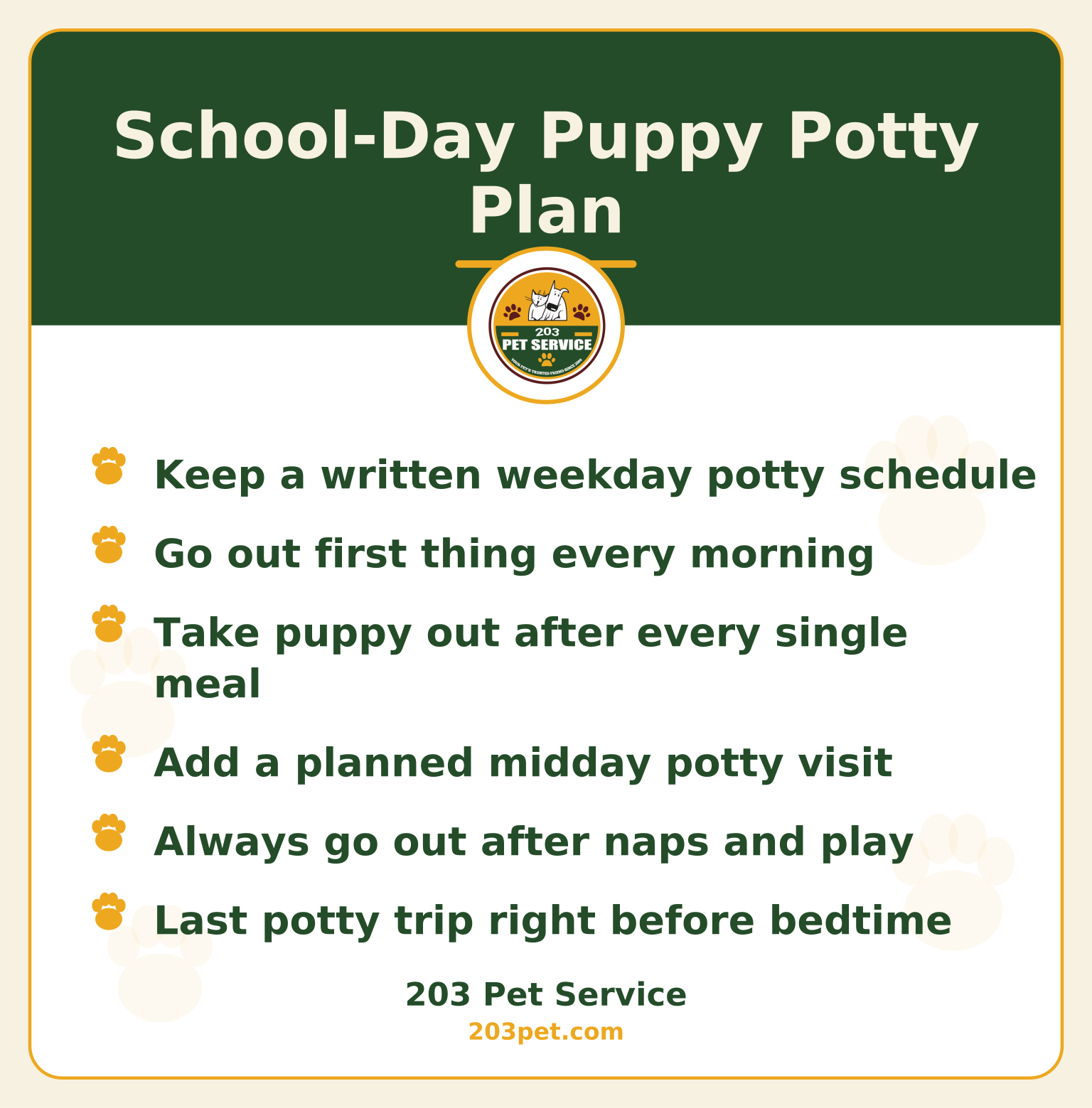
The AKC potty training guide recommends a regular schedule: first thing in the morning, after each meal, after play, after naps, and right before bed. In summer, you might hit most of those just by being home. In fall, you need a written plan.
For a typical family in Fairfield or Westport with school-age kids and parents commuting or working from home on calls, a realistic weekday schedule might look like this:
- 6:30 a.m. - Wake up, straight outside for a potty trip.
- 7:00 a.m. - Breakfast, then outside again right after eating.
- 8:00 a.m. - Short walk or yard time before everyone leaves.
- 11:00 a.m. to 1:00 p.m. - Midday visit from a professional dog walker to give a potty break, short walk, water check, and some calm interaction.
- 3:00 p.m. or 4:00 p.m. - After school potty break and light play.
- Evening - Walk, play, training, and one last potty trip right before bedtime.
Without that midday piece, you might accidentally ask your 12 week old puppy to go from 8 a.m. to 3 p.m. with no break. That's a long time. If they have an accident in their crate or pen at 1 p.m., they don't think, “My bladder was overtaxed.” They just learn, “Sometimes I go inside.” That muddies the training picture.
Another key piece is consistency. Puppies learn by repetition. The AKC puppy training timeline stresses that puppies are ready to learn from the moment they come home, and that you should build the habits you want early. When a walker comes at the same general time each weekday, your puppy’s body starts to expect that pattern. That helps house training more than any fancy gadget.
Families in Stratford and Southport often tell us that after a few weeks of regular midday walks, their puppies start waiting at the door around that time. That is exactly what you want. Strong patterns beat willpower every time with a young dog.
If you're not sure how often your puppy needs a visit, we usually talk through age, current success, crate training, and your daily routine during our company introduction and planning call. Then we match that with the right walking membership so your puppy has support every weekday, not just once in a while.
Should I crate my puppy when the house is empty?

Most puppies do best in a properly sized crate or safe pen when the house is empty, as long as you pair that with enough breaks and positive training. A crate keeps your puppy safe, protects your home, and actually helps many puppies relax instead of pacing or panicking.
Crate training should never mean “shut the puppy in and hope for the best.” The AKC crate training guide suggests starting with short, positive crate sessions, using food and toys, and slowly building duration. The crate should be big enough for your puppy to stand up, turn around, and lie down comfortably, but not so huge that they can potty in one corner and sleep in another.
In Fairfield and Bridgeport, I see plenty of families who buy a large crate their puppy can “grow into.” That usually backfires. Use a divider, or start with a smaller crate and size up later. When a crate is the right size and you take your puppy out often, you encourage their natural instinct not to soil their sleeping area.
Here is where a midday dog walking membership matters. You can crate your puppy from 8 a.m. to 11:30 a.m., have a walker do a potty break and a walk, then settle your puppy back in with a chew toy or stuffed food puzzle. In practice, this is what works best for many of our puppy clients in Westport and Easton.
If you work long days or have a rotating schedule, you can also blend crate time with a puppy-safe room or pen setup. The AKC puppy preparation checklist talks about creating a safe space with puppy-proofing, secured wires, and safe chew options. A walker can move your puppy between those spaces during the day so they're not stuck in one spot for too long.
Done well, the crate becomes a cue for rest, not punishment. I have walked into many homes in Southport where I open the crate door, the puppy stretches, and then happily walks out ready for a break. That's what you want to build this fall.
Video: AKC trainers walk you through crate training step by step so your puppy feels safe and relaxed when crated.
How do I socialize my puppy safely while everyone’s at school?

You socialize your puppy safely by giving them steady, positive exposure to normal sights, sounds, people, and surfaces, without flooding or scaring them. A trained walker can help by offering calm handling, short walks in different spots, and careful introductions along the way.
Healthy socialization is not about random chaos. it's about controlled, positive experiences. The sensitive socialization window for puppies runs roughly up to 16 weeks. The AKC vaccination schedule guide reminds owners that until vaccines are complete, you should avoid high-risk dog areas, but you can still safely expose your puppy to the world from a distance.
For families in Fairfield or Black Rock, that can look like a midday walker taking your puppy:
- On quiet neighborhood walks to see bikes, trucks, and delivery people go by.
- Past schools at a distance at pick up time, once vaccines are up to date.
- Across different surfaces like grass, pavement, gravel, and indoor flooring.
- To the end of the driveway to calmly watch the garbage truck or mail carrier.
Socialization also includes handling. Gentle handling of paws, ears, collar, and use now makes vet visits and grooming easier later. The UC Davis Veterinary Hospital’s pet health resources often highlight how low-stress handling in early life reduces fear and anxiety in adult dogs.
When a regular walker is part of your puppy’s week, your dog learns that more than one human can safely handle them. In Westport and Bridgeport, we've had many puppies who started with us at 10 or 12 weeks. By the time they're 6 months, they greet their salaried walker like family, which makes future boarding, vet transport, and any emergency care easier on everyone.
One more benefit. Many puppies have a mid-day energy spike. Without an outlet, that energy turns into mouthing, barking, or general chaos when the kids finally walk in. A short walk, some sniffing time, and a bit of basic training with the walker can take the edge off so your kids come home to a calmer dog that's ready for homework time and family life.
Why do early habits with a puppy matter so much?

Early habits matter because puppies learn what “normal life” looks like in the first months, and those expectations stick. If you build a calm, predictable routine now, you make the next 10 to 15 years easier. If you let random patterns take over, you'll spend those years fighting what you built.
The AKC puppy training timeline explains that puppies start forming behavior patterns very early. They do not wait until obedience class. Every day at home you either reward the habits you want or the ones you don't want, often without meaning to.
In Fairfield County homes from Fairfield to Weston and Wilton, I see the same three habits make the biggest difference long term:
- A reliable potty routine, so the dog knows where to go and can hold it until then.
- A clear pattern of calm alone time, so the dog doesn't panic when you leave.
- Regular, right-sized exercise and mental work, so the dog does not invent its own “job” like chewing the couch.
Back-to-school season is the perfect time to choose those habits on purpose. For example, you might start a weekday pattern where your puppy expects:
- Morning walk and training with you.
- Quiet crate time while the house is empty.
- Midday walk and potty break with their regular walker.
- Afternoon play with the kids after school.
- Evening family time in one part of the house.
That rhythm teaches your puppy that people come and go, but care and attention stick around. It also gives structure to their exercise. According to the AKC’s exercise needs by breed guide, most puppies need several short play sessions and walks spread through the day rather than one long burst. A walker who knows dogs can pace that for your puppy’s age and breed mix.
When early habits go wrong, the problems often show up months later. Separation issues, leash pulling, constant scavenging for food, or over-excitement with guests usually have roots in puppyhood. Regular support this fall can help you avoid those headaches now rather than paying a trainer to unwind them later. Though if you do need extra help, our professional dog training services in Fairfield County are set up for that too.
Why does it matter who walks my young puppy?

It matters who walks your young puppy because every interaction teaches them something, and you want those lessons to be safe, steady, and in line with your training goals. You also want someone who can spot health issues early and respond correctly in an emergency.
At 203 Pet Service, we use trained, insured W-2 employees, not gig workers. That means the same core group of walkers in Fairfield, Stratford, Westport, and the rest of our full service towns handle puppy visits, and they're accountable to our standards. With 29 years of professional experience in the pet care industry behind 203 Pet Service, including my time as a veterinary technician at Greenfield Animal Hospital in Fairfield, we build puppy care around real-world medical and behavior knowledge, not guesses.
Young puppies are still finishing vaccine series, teething, growing fast, and exploring everything with their mouths. The AKC vaccination guide and the AKC first aid overview both stress that owners and caregivers should know vaccine timing, watch for signs of illness, and respond quickly if something seems off. Our salaried employees are trained to:
- Follow your vet’s guidance on where your puppy should and shouldn't go yet.
- Watch for signs of tummy upset, lethargy, limping, or unusual behavior.
- Know which human foods are unsafe, guided by resources like the AKC human foods list for dogs.
- Use calm, reward-based handling so walks and crate time stay positive.
If a puppy ever has an emergency on a visit, we follow a clear protocol. The walker calls Robyn, our office manager, right away. Robyn reaches out to you. The walker stays with your dog until we've a plan, whether that means monitoring at home or heading to your trusted veterinary partner. For more serious issues, we often recommend MedVet Norwalk or, depending on your vet’s advice, VCA Shoreline Animal Hospital on Bridgeport Avenue in Shelton, and we always respect your established relationship with places like Greenfield Animal Hospital in Fairfield.
Frequently Asked Questions

About This Topic
How long can I safely leave my new puppy alone at home?
Most young puppies can only hold their bladder for about one hour per month of age, up to four hours max. If school and work keep you out longer, it’s too much alone time. That’s when daytime help really matters. 203 Pet Service can provide consistent midday potty breaks and play so your puppy stays on track.
What should my puppy’s weekday routine look like once school starts again?
Aim for a simple pattern: potty, play, train, then rest. In the morning, do a potty break, breakfast, and a short training session before everyone leaves. Midday, arrange a potty break and some gentle play, then another break, dinner, and training in the evening. 203 Pet Service can handle those important midday walks in Fairfield County.
How do I stop my puppy from regressing on potty training in fall?
Regression usually happens when the schedule suddenly changes and potty breaks get spaced too far apart. Use a timer and keep daytime breaks frequent, especially between 10 and 16 weeks. If no one’s home, book a regular midday visit with 203 Pet Service so your puppy doesn’t have to “hold it” and start having accidents again.
My puppy cries when the kids leave for school, what can I do?
Start by making departures boring and predictable, no big goodbyes at the door. Give your puppy a stuffed Kong or safe chew right before you leave and keep the TV or soft music on for background noise. If you’re gone for long stretches, a midday visit from 203 Pet Service can break up the quiet and ease that emotional drop-off.
How can I keep socializing my puppy once school and activities get crazy?
You don’t need marathon outings, short, positive experiences a few times a week are enough. Think quick walks near schools, calm visits to parking lots, or meeting one friendly dog at a time. 203 Pet Service walkers can also provide structured socialization time during weekday visits around Fairfield, Westport, Stratford, and nearby towns.
Is it okay to crate my puppy while everyone’s at school and work?
Crates are fine in reasonable stretches, but they’re not all-day containers. Young puppies need frequent breaks to potty, stretch, and explore, or you’ll risk anxiety and accidents. If your schedule means they’d be crated more than a few hours, combine a crate or playpen setup with a scheduled midday walk from 203 Pet Service.
What’s the best way to transition my puppy from summer to school schedule?
Don’t flip the routine overnight; start shifting it a week or two before school. Move breakfast, walks, and naps gradually to the times you’ll use during the school year. Then plug in support where there are gaps, like a standing midday dog-walking membership with 203 Pet Service so your puppy’s day still feels predictable and supported.
About 203 Pet Service
What areas does 203 Pet Service cover in Fairfield County?
We provide professional dog walking, pet sitting, and training services across Eastern Fairfield County, Connecticut. We proudly serve families in Fairfield, Stratford, Westport, Easton, Southport, Black Rock, Bridgeport, Shelton, Devon, Trumbull, Weston, and Wilton. 203 Pet Service has cared for pets in Fairfield County since 2004, and every visit is handled by a trained, W-2 salaried employee who is background checked and fully insured.
Why does 203 Pet Service use salaried W-2 employees instead of independent contractors?
We believe salaried W-2 employees provide more reliable, accountable, and professional pet care. Unlike independent contractors, our salaried employees go through careful background checks, full training, and are fully insured. This employment structure means consistency, accountability, and peace of mind for Fairfield County pet families.
What qualifications do 203 Pet Service employees have?
Every member of our salaried W-2 team goes through careful background checks, professional pet care training, and ongoing education in animal behavior and safety. Owner Jason Hofmann personally trains each employee, drawing on 29 years as a veterinary technician, pet store manager, and ABC-certified dog trainer. We don't hire hobby pet sitters. We employ career pet care professionals.