

Complete Guide to Domer 3B Cold Laser Therapy for Dogs
Quick Answer
Domer 3B cold laser therapy is a low level light treatment you can use at home to help your dog’s joints feel better, ease inflammation, and support healing in about 23 minutes per session. You move the handheld laser slowly over safe points on your dog’s body in a set pattern, on a schedule you and your veterinarian decide together.
Complete Guide to Domer 3B Cold Laser Therapy for Dogs: 23‑Minute At‑Home Treatment Protocol
Cold laser therapy for dogs uses focused light to help reduce pain and inflammation and to support healing. The Domer 3B gives you a safe, Class 3B way to do that at home, in a structured 23‑minute routine. This guide walks you through what the Domer 3B is, which dogs it can help, and exactly how to use it in a simple, repeatable protocol you can discuss with your veterinarian.
This is educational only. It is not veterinary advice. I am not your veterinarian. Always talk with your vet before you start any dog laser therapy at home, especially if your dog has arthritis, hip dysplasia, or any other medical condition.
Introduction: What is cold laser therapy for dogs?
Cold laser therapy, sometimes called LLLT or photobiomodulation, uses low‑level light to stimulate cells. It is not a cutting surgical laser. It is a gentle light that aims to support healing, reduce inflammation, and ease pain in tissues like joints, muscles, and nerves.
Veterinarians use cold laser therapy every day for arthritis, post‑surgery healing, sprains, and chronic pain. When you look at common problems in senior dogs, like osteoarthritis and mobility issues, it makes sense that more people want a safe way to add this to their home care plan. The American Kennel Club notes that arthritis is one of the most common conditions in older dogs and often needs a mix of pain control, weight management, and lifestyle changes.
So who is this guide for? It is for you if:
- You have a senior dog with arthritis, hip dysplasia, or weak back legs.
- You want to support your dog between vet visits.
- You are willing to be consistent and careful with a structured protocol.
It is also for people who live right here in Fairfield County. Many of our clients in Fairfield, Stratford, Westport, Easton, Southport, Black Rock, and Bridgeport ask about safe home options to go along with their vet care. We also hear the same questions from dog owners in our limited‑service towns like Shelton, Devon, Trumbull, Weston, and Wilton, especially when getting to the vet multiple times a week is hard.
One more time for clarity. This guide explains how I use the Domer 3B with my own dog. It is not a replacement for your veterinarian. Always talk with your vet before you change medications, start cold laser, or adjust your dog’s exercise routine. For bigger picture help with senior dog routines, daily walks, and potty breaks, our W‑2 salaried employees can also support you with dog walking and pet sitting while you handle the medical side with your vet.
Video: Domer 3B Cold Laser Therapy for Dogs: Complete 23-Minute Treatment Protocol for Arthritis & Mobility
Why I Started Using the Domer 3B: Max's Story
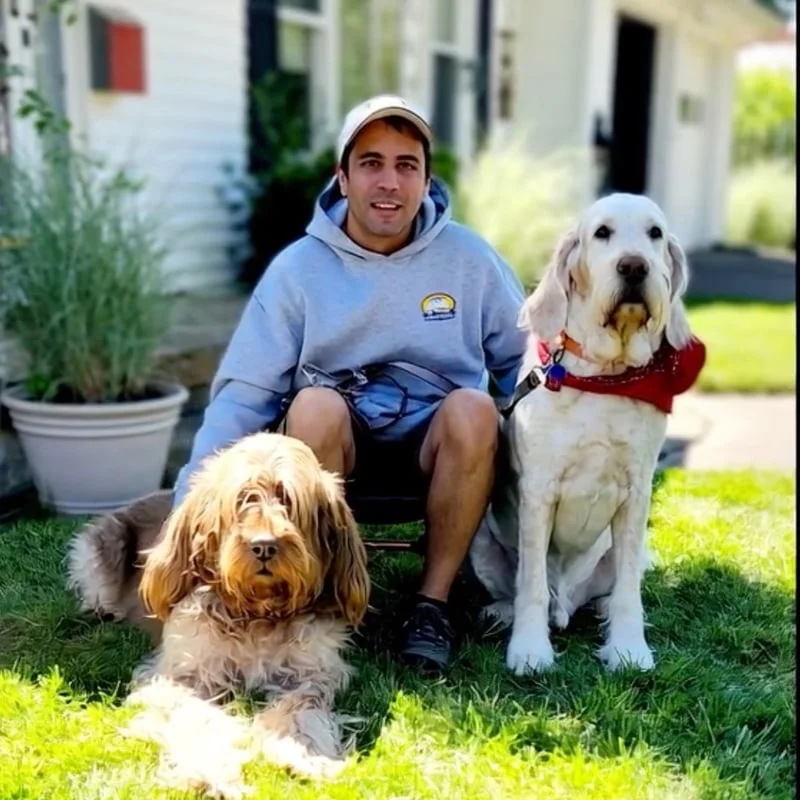
My dog Max is a 12‑year‑old Spinone Italiano. Big, goofy, sensitive. If you have a big senior dog at home, you know the story. They still wag like puppies, but the body does not always keep up.
Max started having episodes where his hind end just gave out. He would be standing, then suddenly his back legs collapsed. Scared him. Scared me more.
We rushed to VCA Shoreline Animal Hospital on Bridgeport Avenue in Shelton, not Bridgeport. Shoreline is one of the emergency hospitals we recommend to our clients when something happens while our W‑2 employees are caring for a dog. After the emergency visit, we followed up with cold laser therapy at Greenfield Animal Hospital in Fairfield, where I worked for five years as a veterinary technician.
I watched Max change in front of me. After each clinic laser session, he was looser, more comfortable, and more willing to walk. He could get up with less struggle. It felt like someone took ten years off his joints.
Then I learned the hard part. Cold laser is cumulative. It is not a one-and-done magic fix. The relief faded between visits, and the weak-hind-end episodes came back. The vet recommended multiple sessions a week at first, which is pretty common for chronic issues according to senior dog care guides from PetMD.
Each trip to Greenfield Animal Hospital took about 90 minutes door to door from my place in Fairfield. By the time I loaded Max, drove, waited, did the treatment, drove back, and got him settled, the morning was gone. That is tough when you own a pet care business, manage dog walking in Fairfield and Westport, and keep things running for families in places like Trumbull and Wilton.
I knew the treatment helped. I also knew I could not keep that schedule long term. So I did what I always do. I dug into the research, talked with veterinarians I trust, and looked at home options.
That is how I ended up with the Domer 3B.
After about a month of using a structured 23‑minute protocol at home, Max stopped collapsing. He now walks up and down the stairs on his own. Before, I had to walk behind him with a hand under his belly like a spotter. We are not pretending he is two years old again, but his quality of life is better. That is what matters.
I am still working for more progress and will keep using the Domer 3B, especially on his hips, stifles, and paws. But based on what I have seen with my own dog, I would buy it again.

What is the Domer 3B cold laser device?
Device overview in plain terms
The Domer 3B is a Class 3B cold laser unit. It uses low‑level light to treat small areas like joints and along the spine. Compared with the big Class 4 lasers you see in some vet clinics, it is lower power, more portable, and meant for careful home use under veterinary guidance.
You hold the Domer 3B a short distance from your dog’s skin and move it slowly over the treatment area. You can set it to continuous or pulsed modes and different power levels. For this guide, I use Level 3 in pulsed mode for all areas. We will keep it simple and repeatable.
The device is FDA registered as a Class 3B therapeutic laser. That does not mean it is a toy. Class 3B can still cause burns and eye injury if you ignore the rules. In a minute, we will go over those safety rules in detail.
As for cost, the Domer 3B sits in the “serious but not insane” range. It is more than a cheap gadget you might find online, but far less than a clinic‑grade Class 4 unit. You can see current pricing and order through this referral link: healthcaremarts.com/?ref=203pet. If you are balancing that with vet visit costs, we will break down the math later.
How cold laser therapy works
Cold laser therapy uses specific wavelengths of light that pass through the skin into the tissues below. Those light photons get absorbed by cells, especially in the mitochondria, which helps boost energy production. That extra cellular energy can support repair and reduce inflammation. It is a bit like turning up the dimmer switch on your dog’s healing processes.
In many dogs with arthritis, pain and stiffness tie back to chronic inflammation in the joints. When you reduce that inflammation and help muscles relax, the dog can move more comfortably. The AKC arthritis guide explains that long term joint care often combines medication, weight control, exercise changes, and supportive therapies like physical therapy or laser.
Key point. With cold laser, results build over time. You do not “fix” a chronic hip or knee in one session. You stack many small treatments. That is why an at‑home protocol can make sense, especially if you live in towns like Weston or Devon where frequent clinic trips are a bigger project.
How is a Class 3B laser different from a Class 4 laser?
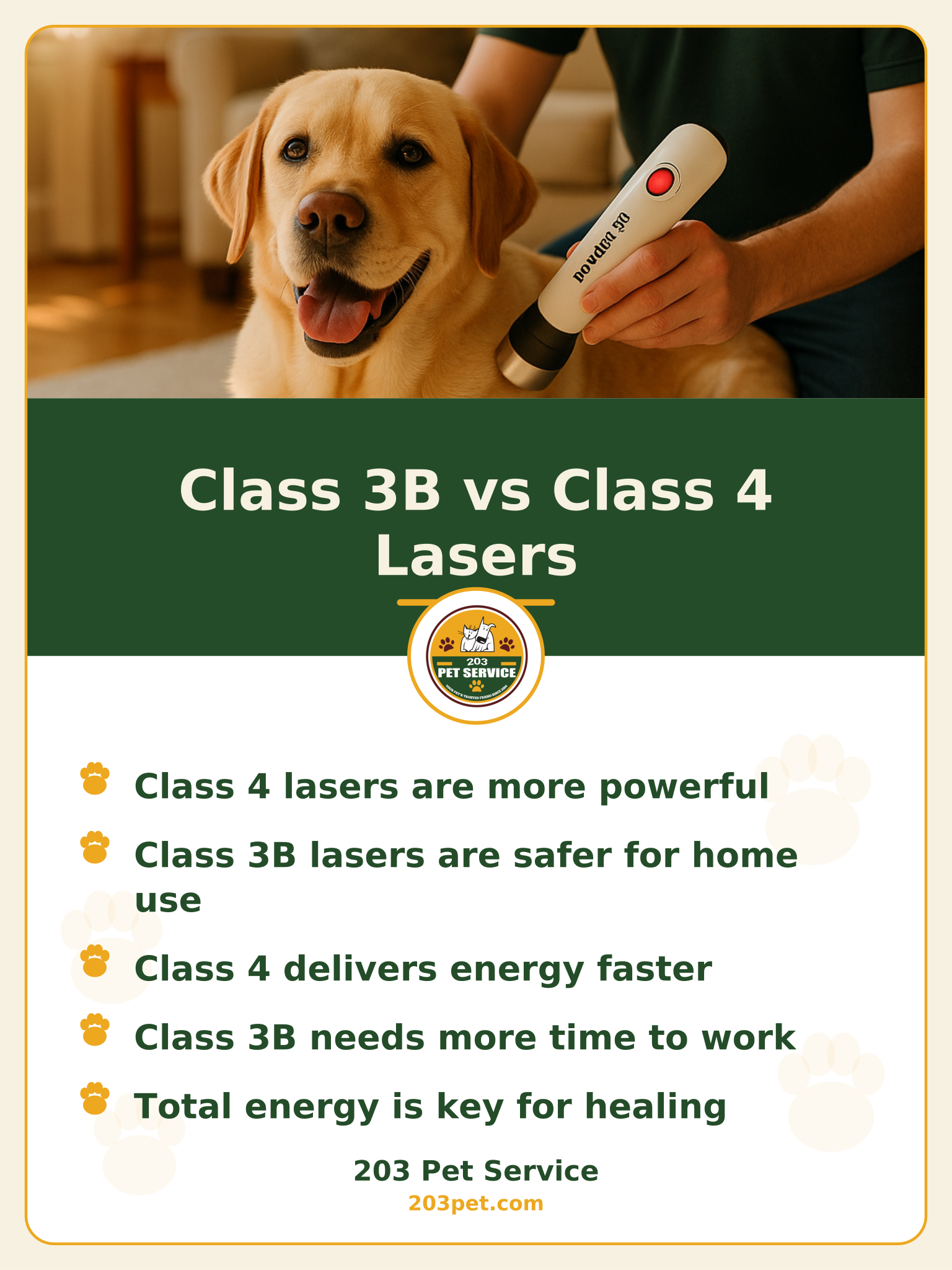
A Class 3B and a Class 4 laser both deliver healing light. The main differences are speed, power, and risk. Class 4 units are stronger and usually used in clinics by trained veterinarians or technicians. Class 3B units like the Domer 3B are lower power and often used for home care under vet guidance.
The simple analogy
Think of water on a lawn. A fire hose is like a Class 4 laser. A garden hose is like a Class 3B laser. Same water, different speed. If you let the garden hose run long enough, the lawn still gets soaked.
Cold laser works the same way. What really matters is how much total energy reaches the tissue, measured in joules per square centimeter. Class 4 delivers it fast. Class 3B delivers it slower but can reach a similar total if you give it enough time.
The math made easy
You only need one simple idea. Power times time equals energy.
- Power is how strong the laser is.
- Time is how long you treat the area.
- Energy (in joules) is what the tissue receives.
So a Class 4 laser might treat a hip for a minute. A Class 3B might need several minutes for the same total energy. That is why our 23‑minute protocol spreads time over multiple joints and spine sections.
Side by side comparison in plain English
- Power: Class 4 is higher power, Class 3B is lower.
- Treatment time per area: Class 4 is shorter, Class 3B is longer.
- Depth: Class 4 gets a bit deeper. For most joints like knees, hocks, and many hips, Class 3B can still reach the tissues, it just needs repeated sessions.
- Where used: Class 4 mainly in clinics. Class 3B often at home with vet guidance.
- Who uses it: Class 4 usually a veterinarian or trained clinic employee. Class 3B can be a dog owner who is trained by their vet and follows a written protocol.
- Safety: Both can hurt eyes and skin if you misuse them. Class 4 can burn faster. Class 3B is more forgiving but still needs respect.
The honest safety difference
A Class 4 laser can burn tissue quickly if someone holds it in one spot or uses the wrong setting. That is one reason clinics use it in controlled ways. A Class 3B like the Domer 3B is less likely to burn, but it is not impossible. You must keep it moving, follow time limits, and use eye protection for both you and your dog.
In my mind, this is the trade‑off. You accept longer sessions at home in exchange for a bit more safety cushion compared with a powerful Class 4. But you still treat the Domer 3B like real medical equipment, not like a flashlight.

Which dogs benefit most from cold laser therapy?
Dogs with chronic pain, joint disease, or certain soft‑tissue injuries often get the most from cold laser therapy. It works best as one piece of a full plan that can include weight control, pain medication, gentle exercise, and home management. That is exactly what senior dog articles from PetMD recommend.
Primary conditions that may benefit
- Osteoarthritis in hips, knees, elbows, or spine.
- Hip dysplasia pain and stiffness.
- Degenerative joint disease in senior dogs.
- Post‑surgical recovery after orthopedic surgery, with your vet’s protocol.
- Chronic back pain or weak hind end from degenerative changes.
- Paw neuropathy in older dogs that drag their toes or walk flat‑footed.
Cold laser is not a cure for arthritis. It is a tool to help manage pain and keep your dog moving. For many senior dogs we walk in Fairfield, Westport, and Wilton, even small gains in comfort make daily life easier. They can walk farther, sniff longer, and sleep more deeply.
Symptoms to watch for
If you see any of these signs, talk with your veterinarian about pain management. They may suggest laser therapy in clinic or approve a home device.
- Limping or favoring one leg.
- Stiffness after rest, especially in the morning.
- Trouble standing up or climbing stairs.
- Slipping on wood or tile floors.
- Less interest in walks or play.
- Whining, panting, or restlessness at night.
- Growling or snapping when you touch certain joints.
When should you not use cold laser therapy?
There are times you should avoid cold laser or only use it under very tight veterinary control.
- Known or suspected cancer in the treatment area.
- Over the thyroid gland.
- Pregnant dogs (especially over the abdomen).
- Active infections or open wounds, unless your vet gives written directions.
- Dogs with seizure disorders if your vet advises against light‑based therapies.
Some of these concerns tie back to how cells respond to light, and your vet is in the best spot to judge what is safe. If your dog is already on a complex care plan for other diseases, like severe obesity, diabetes, or heart problems, that needs to be part of the discussion too. VCA explains how much body condition affects joint pain and overall health in their article on obesity in dogs, and that plays right into arthritis management.

What safety rules should I follow with the Domer 3B?
The most important safety rules with the Domer 3B are simple. Keep the laser moving, protect all eyes, and stick with the agreed settings and times. If you respect those three rules, you lower the chance of burns or other problems.
The golden rule: keep it moving
Never hold the Domer 3B still on one spot. That is how you create a hot spot and risk a burn. Instead, sweep the beam slowly back and forth, or in small circles, over the treatment area.
Think of painting with a brush. You want even coverage, not a big blob in the middle. Move at a pace where it takes about 5 to 10 seconds to cross a 2‑inch area, then come back and repeat. Stay a short distance off the skin, just as the device instructions show.
Eye safety for you and your dog
Laser light and eyes do not mix. Keep the beam away from all eyes, always.
- Do not point the laser at your dog’s face.
- Do not use it near your own eye level.
- Use canine‑safe goggles if your vet recommends them and your dog will tolerate them.
- Position your dog so you are working on the side or behind the head, not near the eyes.
If you have kids in the house, put the Domer 3B away between sessions, just like you would with medications or sharp tools. In homes where our salaried employees provide pet sitting in places like Trumbull or Devon, we always ask owners to store devices and meds safely so no one bumps them by accident.
Device settings for this protocol
For the 23‑minute protocol I use:
- Mode: Pulsed.
- Power level: Level 3.
I do not change these unless a veterinarian tells me to and explains why. Using one steady setting makes it easier to avoid mistakes and to track how your dog responds across weeks.
Before you start, show the device and this protocol to your vet. Ask them to confirm that these settings and times fit your dog’s size, medical history, and diagnosis. For very small dogs, your vet may lower times per area. For very large dogs, they might approve slightly longer sessions in some spots.
Video: Domer 3B Cold Laser Therapy for Dogs: Complete 23-Minute Treatment Protocol for Arthritis & Mobility
How does the 23‑minute Domer 3B protocol work?
The full session runs about 23 minutes and covers spine, hips, knees, hocks, and paws. You can do it once or twice daily for five days in a row, then rest two days. That weekly rhythm helps you build up benefits without overdoing it.
Basic layout:
- Spine and lower back: 5 minutes.
- Hips: 5 minutes.
- Knees (stifles): 5 minutes.
- Hocks (ankles): 5 minutes.
- Paws and neuropathy work: 3 minutes.
Before each session, set your dog up in a calm space. I like a soft mat or dog bed that does not slide on the floor. Many of our clients in Westport and Southport pick a quiet corner where kids are not running through and the TV is low. Think of it like a mini physical therapy appointment in your living room.
Frequently Asked Questions
About This Topic
How do I actually use the Domer 3B cold laser on my dog?
You’ll move the handheld laser slowly over pre‑mapped points on your dog’s body, usually joints and spine, for about 23 minutes total. Keep the head in light contact or just off the fur and move in a steady pattern, not random circles. Your vet can help you mark safe spots. 203 Pet Service can also walk you through the protocol in person.
What kinds of problems can Domer 3B cold laser help my dog with?
Most owners use the Domer 3B for arthritis pain, hip or elbow dysplasia, post‑surgery recovery, chronic back pain, and soft‑tissue injuries like sprains. It’s designed to reduce inflammation and support healing, not replace medications or surgery. Your vet should confirm it’s appropriate for your dog’s specific diagnosis.
How often should I do Domer 3B laser sessions and when will I see results?
Many dogs start with 3 or 4 sessions per week for a few weeks, then taper to a maintenance schedule like once or twice weekly, but your vet should set the exact plan. Some dogs seem more comfortable after 2 or 3 sessions, while others need a few weeks. The protocol I am following is 1 or 2 sessions a day for five days and then two days off.
Is Domer 3B cold laser therapy really safe to use at home on dogs?
When you follow your veterinarian’s instructions and the device’s safety guidelines, Class 3B cold laser is generally considered safe. You shouldn’t shine it in eyes, on tumors unless a vet approves, or over the abdomen of pregnant dogs. Stop immediately if your dog seems distressed or worsens. 203 Pet Service can demonstrate safe handling and help you avoid common mistakes.
Can I use Domer 3B cold laser instead of pain meds for my dog’s arthritis?
You shouldn’t stop prescribed medications without your vet’s okay. The Domer 3B is usually an add‑on therapy that can lower inflammation and sometimes allow your vet to reduce drug doses over time. Think of it as part of a full pain‑management plan, including weight control and exercise.
How do I know if my dog is a good candidate for Domer 3B laser?
Good candidates are dogs with chronic joint pain, stiffness, or slow‑healing soft‑tissue injuries whose vet wants non‑drug support. Dogs with certain cancers, bleeding disorders, or active infections may need extra caution or should avoid it entirely. Your vet must screen for those issues first. 203 Pet Service can help you prepare videos and notes about your dog’s movement to share with your veterinarian.
What should I watch for during a Domer 3B session to keep my dog comfortable?
Look for relaxed body language, soft eyes, normal breathing, maybe even dozing. If your dog pants hard, tries to escape, or seems painful when you pass over a spot, pause and check with your vet before continuing there. Keep sessions calm and use a nonslip mat or bed. In my experience, most dogs find the treatment deeply relaxing, with many even drifting off to sleep.
Do I need any special training before doing Domer 3B cold laser therapy at home?
When you purchase the Domer 3B Cold Laser directly from the manufacturer, you will receive comprehensive treatment protocols designed for both humans and pets. For a more tailored approach, we recommend consulting your veterinarian or reaching out to a veterinary telehealth service like AirVet. Additionally, if you are located within our Fairfield County service area, 203 Pet Service can provide personalized, in-home coaching to guide you through your first few sessions.g the device.
About 203 Pet Service
What areas does 203 Pet Service cover in Fairfield County?
We provide professional dog walking, pet sitting, and training services across Eastern Fairfield County, Connecticut. We proudly serve families in Fairfield, Stratford, Westport, Easton, Southport, Black Rock, Bridgeport, Shelton, Devon, Trumbull, Weston, and Wilton. 203 Pet Service has cared for pets in Fairfield County since 2004, and every visit is handled by a trained, W-2 salaried employee who is background checked and fully insured.
Why does 203 Pet Service use salaried W-2 employees instead of independent contractors?
We believe salaried W-2 employees provide more reliable, accountable, and professional pet care. Unlike independent contractors, our salaried employees go through careful background checks, full training, and are fully insured. This employment structure means consistency, accountability, and peace of mind for Fairfield County pet families.
Is 203 Pet Service insured?
Yes, we are fully insured, with liability and property coverage to protect both your pets and your home. As a real business that employs salaried W-2 people (not independent contractors), we carry all required insurance and workers' compensation coverage. Most of our team is certified in Pet CPR and First Aid, with the rest working toward it. This level of protection is one reason Fairfield County families trust us with their family members.