

Easing Your Dog Back Into a Weekday Routine in September
Quick Answer
To ease your dog back into a weekday routine in September, start shifting walk, meal, and wake up times about a week before schedules change, so the new rhythm feels normal instead of sudden. Add calm alone time while you are still home, stick to a steady morning, midday, and evening pattern, and consider a reliable dog walker if your dog will be alone for long stretches.
Easing Your Dog Back Into a Weekday Routine in September
To ease your dog back into a weekday routine in September, start shifting your schedule a week early, add predictable walks and feeding times, and build in calm alone time so the quiet house does not feel like a shock. A steady morning, midday, and evening rhythm helps your dog feel safe when school and work schedules ramp up again.
In Fairfield County, that summer-to-fall flip can feel pretty sharp. One week the kids are home, you are in and out all day, and your dog tags along to the beach in Fairfield or the ball fields in Stratford. The next week the house is silent by 8 a.m., and your dog is alone, wondering where everyone went.
I have watched this play out for more than two decades with dogs in Fairfield, Westport, Easton, Southport, Black Rock, and Bridgeport. The good news is you can plan for it. With a bit of structure and, if you want it, a steady walking membership, your dog can slide into fall instead of crash into it.
How do dogs feel the change when summer ends and the house suddenly gets quiet?

Dogs feel the change from a busy summer to a quiet school-year house through their routine, not a calendar. When the people, sounds, and activities fall away, many dogs get anxious, bored, or confused.
Think about your dog in July. Kids watching TV in the morning. Doors opening and closing. Trips to Lake Mohegan in Fairfield or walks through downtown Westport. Someone grabbing a snack, then dropping a few crumbs that your dog happily cleans up.
Then September hits. The bus pulls away in the morning, your car leaves the driveway, and your dog is alone with still air and quiet rooms. For a social dog, that silence can feel loud.
Dogs are routine animals. The Merck Veterinary Manual notes that dogs adapt well when their daily care is consistent. When their routine suddenly changes, you often see behavior shifts, not because your dog is being "bad", but because they are trying to cope.
Common behavior changes you might see in September
- Whining or barking after you leave the house
- Following you from room to room on school nights
- Chewing objects they ignored all summer
- Potty accidents after months of doing well
- Pacing, staring at the door, or not settling
Many families in Bridgeport and Stratford call us right after Labor Day and say the same thing. "He was fine all summer, and now he is a mess." Nothing is wrong with your dog. The environment changed overnight. Your dog is reacting to that shock.
So the goal is simple. Make that shift smaller. Not sudden. Not a cliff.
Why should you start your dog's fall routine before school actually starts?
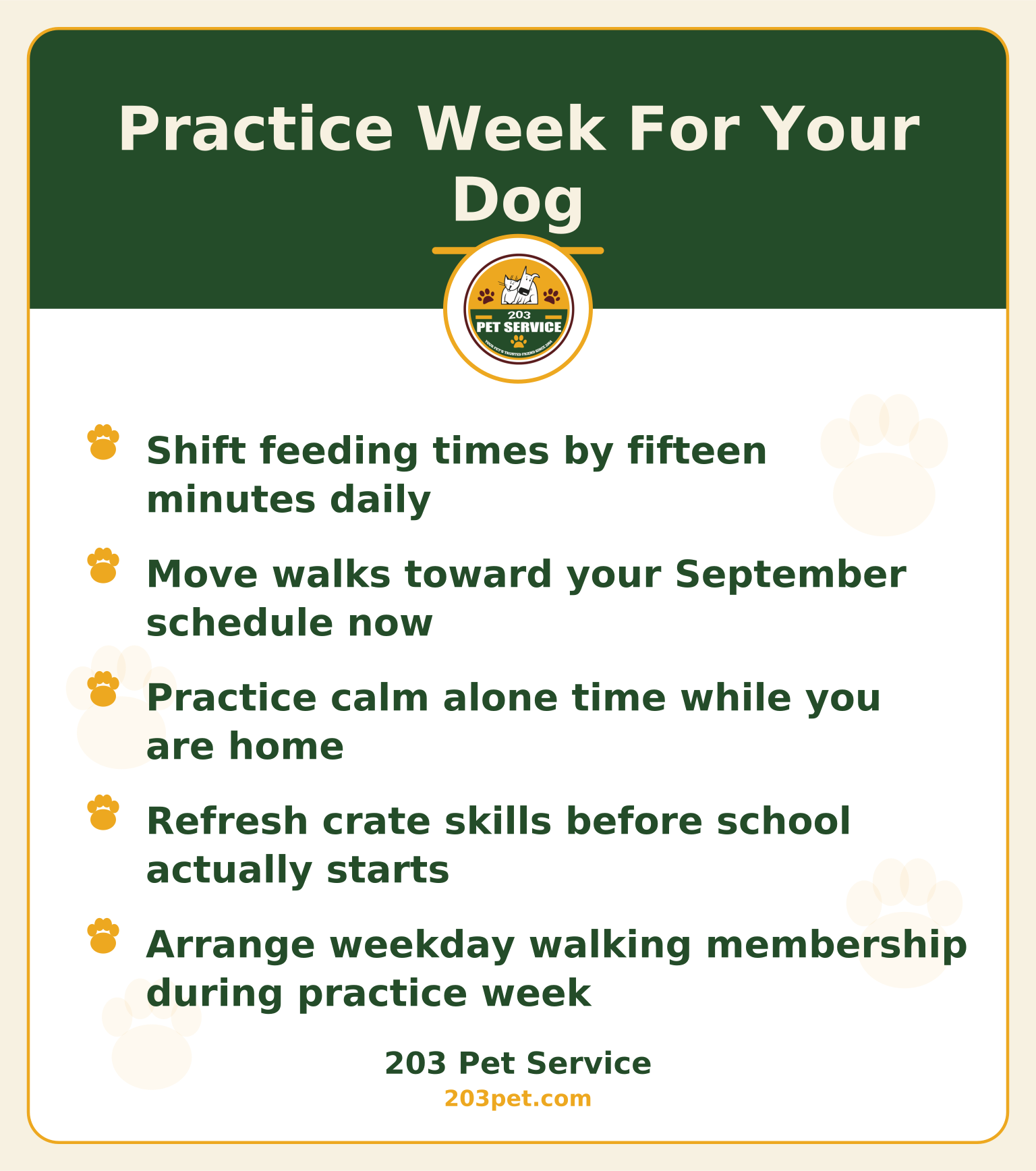
You should start your dog's fall routine about a week before school starts so your dog has time to adjust while you are still around to help. That way, the first day of school is not also the first day of long, lonely hours.
Many families in Fairfield County treat the last week of August like the last big blast of summer. Trips, late nights, extra outings. Fun for you, confusing for your dog once everything slams to a stop.
Instead, think of that final week as "practice week" for your dog. You begin to shift feeding, walks, and alone time to match your September plan. You do not need to run it perfectly. You just want the shape of the school-year day to start to show up.
1. Shift feeding times gradually
If you are moving your dog's breakfast earlier because you need to catch a train from Southport or drive to work in Bridgeport, start sliding that bowl earlier by 15 minutes a day. Same for dinner if kids' sports in Westport or Easton will push the evening routine later.
Dogs handle slow changes much better than fast changes. Just like a new puppy learns a bathroom schedule over time, not in one day. The American Kennel Club potty training guide explains how clear, regular timing helps a dog learn. The same idea applies here.
2. Add short, planned alone times
During that practice week, give your dog some real alone time while everyone is still home from summer break. You might:
- Crate your dog or set them up in a safe room for 30 to 60 minutes while you are in another part of the house.
- Do a quick run to the store and leave your dog with a stuffed food toy and calm music on.
- Send the kids outside to play while your dog stays in the house to rest.
Short, calm separations now help prevent long, stressed separations later. If you plan to use a crate again in the fall, that week is the time to refresh those crate skills, not the night before school starts.
3. Start your September walk schedule early
If you already know you want a weekday walking membership in Fairfield, Stratford, Westport, Easton, Southport, Black Rock, or Bridgeport, you can set it to start that last week of August. That way your dog meets their walker, learns the routine, and sees that even when the house is quiet, someone they know and trust shows up every day.
Our dog walking memberships are set up for this kind of steady pattern. Same days. Same general time. Same salaried employee. That predictability is gold for many dogs once the school buses start rolling again.
How do you build a predictable weekday routine that calms your dog?

You build a calming weekday routine for your dog by creating the same basic pattern every school day: active morning, restful mid-morning, a reliable midday break, then a steady evening wind down. The sameness helps your dog relax, because they know what comes next.
Dogs do not need a complex schedule. They need a clear one. The AKC exercise guidelines explain that dogs need regular physical and mental activity, but how you spread that out matters. A dog that gets all their action in one burst and then nothing for eight hours often struggles more than a dog who gets smaller, steady pieces through the day.
Morning: move first, then leave
The first key is simple. Your dog should move their body and use their brain before you walk out the door. A 5 minute yard break is not enough for most dogs, especially young or working breeds.
In Fairfield or Bridgeport, this might mean a 20 to 30 minute walk through your neighborhood. In Westport or Southport, maybe you walk a quiet route near the water. The goal is not speed. It is a chance to sniff, move, and clear that morning energy.
You can build that into a walking membership too. Many families who commute from Black Rock or downtown Bridgeport schedule their walker for early mornings, so their dog has a full walk right before the house empties out.
Midday: a real break, not just a quick potty
By noon or early afternoon, your dog needs another outlet. If you are home for lunch, plan another bathroom break, a short walk, and a few minutes of simple training or play. Five minutes of "sit", "down", and easy tricks can be just as tiring as a longer walk.
If you are in the office in Fairfield, Bridgeport, or New York, this is where a weekday walking membership really helps. A consistent midday visit breaks up that long stretch of alone time so your dog does not sit and simmer in their own stress all day.
Evening: calm, not chaos
When everyone piles back into the house after work and school, try not to make your dog's whole evening one big party. That might sound odd, but many dogs get overstimulated in those hours. Kids tell stories, backpacks hit the floor, dinner starts, and on top of that, the dog gets wrestled and hyped up.
Instead, think "bookends". A walk or play session before dinner, then a quieter period later. Gentle petting, a food puzzle, or some relaxed training. Dogs need down time to process their day just like you do.
Families who use both weekday walks and occasional pet sitting visits find that their dogs handle busy sports nights better, because their needs are met steadily, not all at once at 9 p.m.
The midday walk as the anchor: why does one visit change the whole day?

A single reliable midday walk often changes your dog's whole weekday because it cuts the longest stretch of alone time in half. Your dog has something to look forward to and a way to release pent up energy and stress.
Picture a 9 a.m. to 5 p.m. workday for you in Stratford or a train to the city from Fairfield. Without help, your dog might be inside from 8 a.m. to 5:30 p.m. That is a lot of hours with no potty break, no walk, no company.
Many dogs in that spot chew, bark, or have accidents simply because they have no other outlet. The UC Davis Veterinary Hospital notes that both physical and mental stimulation help prevent behavior problems. A midday visit checks both boxes.
What a good midday walk should look like
A helpful midday walk is more than a five minute dash. It should include:
- A proper potty break, with time to fully empty bladder and bowels
- A walk long enough to stretch muscles and loosen joints
- Sniffing time, since nose work tires dogs in a healthy way
- Some calm, friendly interaction with a person your dog trusts
In older dogs or dogs with arthritis, the walk might be shorter and gentler. The AKC guide to dog arthritis explains that regular, moderate movement helps keep joints more comfortable. So even a slow, careful stroll in Bridgeport or Easton mid-day can make evenings easier for a senior dog.
Why a weekday walking membership works better than one-off visits
We look at midday walks as an anchor, not a last-minute patch. When your dog knows that Monday through Friday, someone friendly walks through the door at roughly the same time, their whole day organizes around that point.
With a 203 Pet Service walking membership in Fairfield, Stratford, Westport, Easton, Southport, Black Rock, or Bridgeport, you get:
- Same W-2 salaried employee on a set schedule
- Regular weekday slots that your dog learns to expect
- Clear communication with our office so you are not scrambling for coverage
Because our walkers are W-2 employees, not contractors, we handle the training, scheduling, and backup when someone is sick. That stability matters. Your dog is not meeting a new face every other week. They build a real relationship with the person who walks them.
Safety and emergency backup
On top of routine, you also want safety. Our walkers are trained in basic first aid concepts that match what the AKC first aid guidelines describe, like watching for signs of heat stress, choking, or sudden pain.
If something ever does go wrong, our emergency protocol kicks in. The walker calls Robyn, our office manager, right away. Robyn contacts you, and your walker stays with your dog until you and your veterinarian give further instructions. We work closely with local veterinarians, including VCA Shoreline Animal Hospital in Shelton, Greenfield Animal Hospital in Fairfield, and MedVet Norwalk for emergencies.
Can crate training help your dog handle the school-year routine?

Good crate training can help many dogs feel safer and calmer during the school-year routine, as long as the crate is introduced as a positive, quiet space and not used as punishment. A crate gives your dog a clear "bedroom" where they know how to rest.
Think of a crate like a kid's room. When you teach your dog that this is their spot to relax, not a place they get sent when they are in trouble, the crate becomes part of the routine that helps them cope with alone time.
Video: This AKC video walks you step by step through positive crate training, so your dog learns to see the crate as a safe, restful place while you are out of the house.
Making the crate part of your weekday rhythm
In the week or two before school, start using the crate for short, happy sessions:
- Feed some meals in the crate with the door open.
- Give a stuffed food toy in the crate while you watch TV.
- Close the door for a few minutes, then calmly let your dog out before they fuss.
The AKC new puppy prep guide talks about setting up safe spaces before a puppy arrives. The same idea works for adult dogs. You set up and practice the routine now, so it feels normal when your actual schedule tightens up in September.
If your dog truly hates the crate, you can use a gated room or a playpen instead. Many of our clients in Fairfield, Westport, and Bridgeport use a baby gate in the kitchen with a bed, water, and a couple of safe toys. The key is consistency. Your dog needs to see the same safe setup every weekday.
When our pet sitting or weekday walking clients ask for help with crating and confinement, we often pair walks with short training sessions. That might mean a few minutes of calm crate games before or after the walk so the dog learns that good things happen in that space.
Why does a walking membership make your dog's new routine stick?

A walking membership makes your dog's routine stick because it removes the guesswork. Same time, same walker, same pattern, every week. Your dog stops wondering if they will get a break and starts counting on it.
In our years serving Fairfield, Stratford, Westport, Easton, Southport, Black Rock, and Bridgeport, I have watched the difference between one-off walks and a steady weekday schedule. The dogs on a real schedule usually settle faster in September, bark less, and show fewer stress signs.
Same walker, same route, same cues
Dogs notice details. When the same salaried employee shows up, uses the same doorway, clips the same leash, and walks a familiar route, your dog relaxes into that habit. That repetition helps the body and brain calm down.
Because we use W-2 employees instead of gig workers, we can keep that consistency strong. Our walkers work in set parts of town. So your Fairfield walker knows the side streets, your Bridgeport walker knows which blocks are quiet during school hours, and your Westport walker knows which times Main Street is busy.
How a membership helps your whole family
The membership does not just help the dog. It helps you too. You do not need to scramble on Sunday night thinking "Who can let the dog out on Wednesday when we are all in different places?"
With a set plan in place, you can focus on school forms, work meetings, or commuting from Southport station without worrying if your dog is crossing their legs all day. Many of our clients tell Robyn that their own stress goes down once they have a weekday membership locked in.
Because we know your routine, we can also adjust within it. If your Trumbull or Devon commute shifts earlier in winter, or your Wilton or Weston workdays change, we talk with you and slide that walk window a bit. Same membership idea, just tuned to your life.
If you want to see how a membership fits your budget, you can check our pricing page for options. We focus on steady, ongoing care rather than one-off stops, because that is what really changes a dog's weekday experience.
Frequently Asked Questions

About This Topic
How soon before school starts should I change my dog’s routine?
Start about 7 to 10 days before your schedule shifts. Move wake-up, walk, and meal times 15 to 20 minutes earlier or later each day until you’re on your fall timetable. Keep the pattern the same every weekday so it feels predictable. If you’ll be gone midday, line up a dog walker, like 203 Pet Service, before the first school week.
My dog gets upset when the kids go back to school, help?
Begin practicing short “quiet house” periods while everyone’s still home. Have the kids ignore the dog for 10, 20 minutes at a time, no big goodbyes or reunions, so calm becomes normal. On school days, keep departures low-key and offer a stuffed Kong or lick mat. If your dog struggles being alone, 203 Pet Service can break up the day with walks.
What’s a good weekday schedule for my dog once fall starts?
Aim for a simple, repeatable rhythm: morning potty and walk, breakfast, a calm alone period, a midday walk or potty break, evening walk and play, then a predictable bedtime. Try to keep walk and meal times within the same 30-minute window each weekday. If you’re at work in Fairfield County, 203 Pet Service can reliably cover that midday slot.
How can I stop my dog from being bored alone all day?
Rotate puzzle feeders, frozen Kongs, and safe chew toys so there’s something new every few days. Leave a snuffle mat or scatter part of breakfast to encourage nose work before naptime. Close blinds if outside activity revs your dog up. For dogs who really need mid-day interaction, ongoing walking memberships with 203 Pet Service add both exercise and company.
My dog suddenly barks and paces after Labor Day, what should I do?
That jump in barking and pacing can be your dog reacting to the quiet house and routine change. First, tighten up a consistent daily schedule and add an extra walk or short training session for mental tiredness. Use white noise or soft music to mask neighborhood sounds. If it continues, ask your vet and consider regular weekday walks with a pro like 203 Pet Service.
Is my dog okay home alone all day, or need a dog walker?
Most healthy adult dogs do best with a potty and exercise break at least every 4 to 6 hours. If your commute means your dog’s crated or alone 7 to 9 hours, a walker’s a smart idea, especially in September when routines flip. In Fairfield County, 203 Pet Service offers consistent midday walks and memberships so your dog isn’t facing those long, silent days alone.
About 203 Pet Service
What areas does 203 Pet Service cover in Fairfield County?
We provide professional dog walking, pet sitting, and training services across Eastern Fairfield County, Connecticut. We proudly serve families in Fairfield, Stratford, Westport, Easton, Southport, Black Rock, Bridgeport, Shelton, Devon, Trumbull, Weston, and Wilton. 203 Pet Service has cared for pets in Fairfield County since 2004, and every visit is handled by a trained, W-2 salaried employee who is background checked and fully insured.
Why does 203 Pet Service use salaried W-2 employees instead of independent contractors?
We believe salaried W-2 employees provide more reliable, accountable, and professional pet care. Unlike independent contractors, our salaried employees go through careful background checks, full training, and are fully insured. This employment structure means consistency, accountability, and peace of mind for Fairfield County pet families.
How do I schedule a meet and greet with 203 Pet Service?
Just call us at (203) 682-6443 or fill out our contact form. We will schedule a meet and greet where you can meet your potential sitter or walker, talk through your pet's needs, and see firsthand why Fairfield County families have trusted us since 2004. There is no obligation, just a chance to see our professional approach to pet care.