
Help Your Newly Adopted Dog Settle Into Calm Routine
Quick Answer
Help a newly adopted dog settle in by keeping life simple, quiet, and predictable from day one. Use the same wake time, walk windows, and meal schedule, give them one safe spot to relax, and limit big changes or new people at first. When everyone in the home follows the same calm routine, most rescue dogs start to feel secure much faster.
Help Your Newly Adopted Dog Settle Into A Calm Routine
Help your newly adopted dog settle into a calm routine by keeping life simple and predictable. Think same wake time, same walk window, same feeding plan, and one quiet space that always feels safe. A steady routine helps your rescue dog relax faster, even on busy Fairfield County weekdays.
I have spent decades helping dogs settle into new homes in Fairfield, Stratford, Westport, Easton, Southport, Black Rock, and Bridgeport. The families who do best are rarely the ones with perfect houses. They are the ones who stick to a simple routine and give the dog time to settle.
What should you do before you bring your new dog home?

Before you bring your new dog home, you should talk with the rescue about your dog’s habits and triggers, set honest expectations for the first month, and agree on who in the household handles walks, meals, and training. If you do this part well, the first weeks feel calmer for both you and your dog.
Start with the rescue or shelter. Ask about what they actually see day to day. Does this dog guard food? Do loud trucks scare them? How do they act in a crate? Talk about energy level and exercise needs too. Different types of dogs need different amounts of activity, which affects your routine and lines up with what the American Kennel Club says about exercise by breed and age.
If they have any medical notes, take those seriously. Ask which vet they used, what medications your dog takes, and when the next shots are due. Puppies and young dogs need a series of vaccines, and that schedule can affect walks and social time. The AKC puppy vaccination guide explains why those early visits matter for outings and safe contact with other dogs.
Next, talk as a family. Who will walk the dog before work? Who handles the last outing at night? Who feeds breakfast and dinner? Write it down if you have to. A lot of stress in those first weeks comes from people assuming someone else already did the walk or already fed the dog.
Set expectations low at first. Many rescue dogs need days or weeks before you see their real personality. Some hardly move the first three days. Others act wild, then crash hard. Both are normal. What matters is that you stay consistent and give clear, gentle structure.
I always tell new clients in Fairfield County to plan on a “quiet month” for a new dog. Fewer social events. Fewer big outings. More boring Tuesdays at home. That boring stretch is where trust grows.
How do you set up a safe, quiet home base?
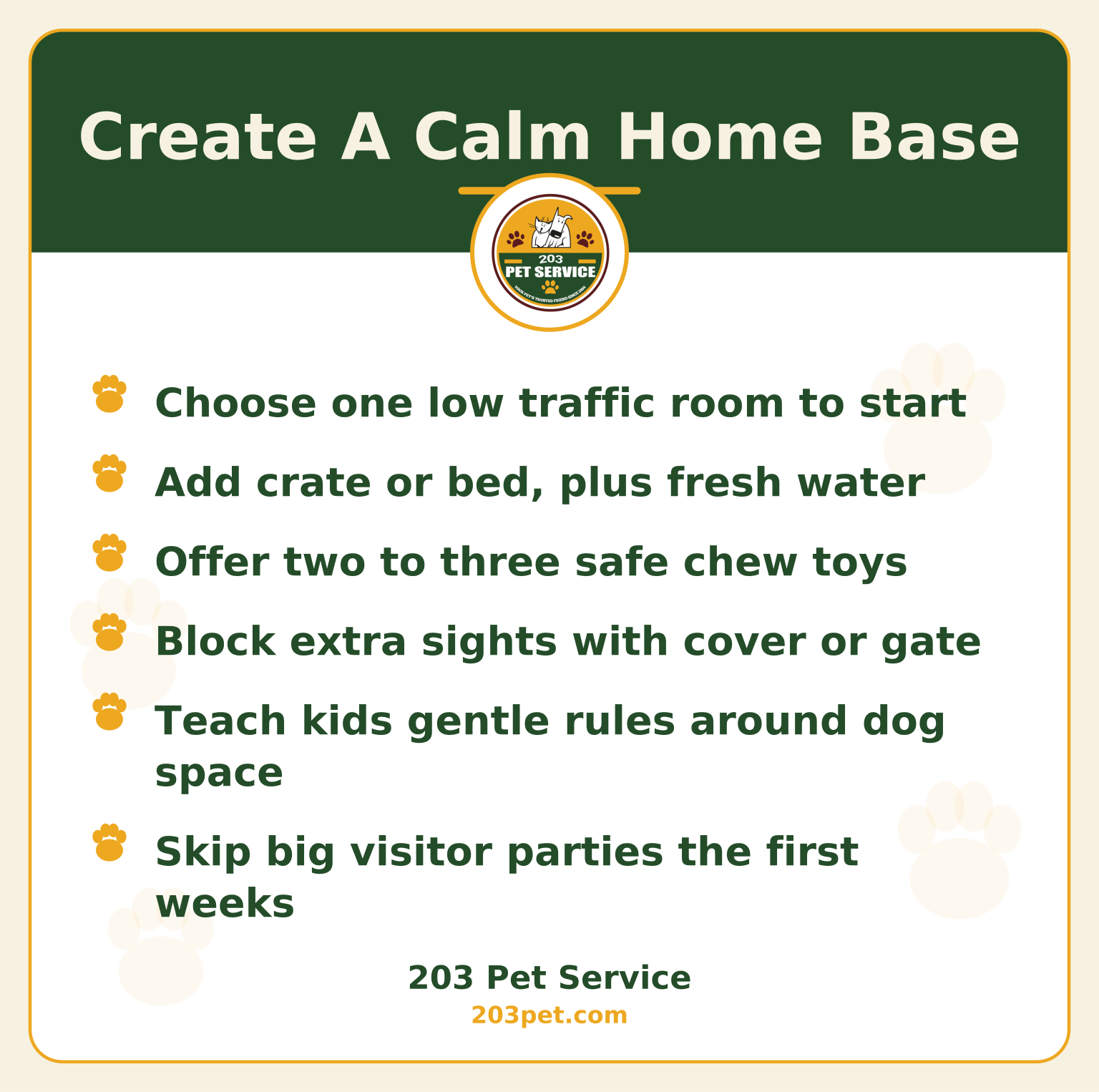
You set up a safe, quiet home base by picking one calm room, keeping the layout simple, and controlling how people and other pets come and go. Your dog needs one place that stays the same, even when the rest of life is busy.
Pick a low traffic room for the first few days. A corner of the living room, a spare bedroom, or part of the kitchen works well. In Westport and Southport, a lot of families use a dining room that people only use at night. In apartments in Bridgeport, it might be a corner by the couch away from the front door.
Think simple setup. Your dog should have:
- A crate or solid bed where they can fully stretch out
- Fresh water that stays in the same spot
- 2 to 3 safe chew toys, not a basket overflowing with options
- Ideally a way to block visual traffic, like a covered crate or a playpen gate
Dogs read their space through scent and routine. When you keep that one area steady, they can start to relax there first. Over time, they will explore more of the house.
Plan ahead if you have kids. Before the dog arrives, talk with them about rules. No hugging the dog, no climbing into the crate, no yelling or running in that room. Young kids mean well, they just move fast. That can scare a dog who is already unsure. The UC Davis Veterinary Medicine animal health topics section points out that stress can worsen many medical and behavior problems, so keeping that first space calm really matters.
Visitors need limits too. For the first two weeks, skip big “come meet our new dog” parties. Let the dog watch from their safe place while one or two trusted people visit quietly. If your dog chooses to walk over and say hi, great. If they hide in the crate, that is fine too. The crate is not a punishment. It is their bedroom.
In older homes in Easton and Stratford, I see a lot of long, narrow hallways and sudden noise from old plumbing. Notice where your house makes sudden sounds. Try not to set up your dog’s space right next to the loudest pipes or the banging back door.
What does a good first week routine for a rescue dog look like?

A good first week routine keeps your days predictable, with the same wake time, meal times, walk windows, and quiet time. Short walks around your own block and consistent, one-word cues for “outside”, “dinner”, and “bedtime” help your dog understand what happens next.
Think about your normal Fairfield County weekday. Maybe you leave for the train at 7:15. Kids leave for school around 8. You come home between 5 and 6. Use that real schedule. Do not pretend you will suddenly wake up an hour earlier if you have never done that before.
Sample first week schedule
Here is a sample for a household that works normal office hours:
- 6:30 am Wake up, quick potty break in the yard or right outside the building
- 6:45 am Breakfast, then 15 to 20 minutes of calm time in the home base area
- 7:15 am Short walk around your block or immediate area
- 8:00 am to 12:00 pm Quiet rest time, chew toys, maybe a frozen Kong
- Midday Potty break and short walk with you or a trusted walker
- 12:30 pm to 4:30 pm Rest time again
- 5:00 pm Potty break and 15 to 25 minute walk
- 6:00 pm Dinner
- Evening Light training or play, then wind down
- 10:00 pm Last potty break and bed
In many parts of Eastern Fairfield County, like Black Rock and Devon, I suggest sticking close to home at first. Walk the same two or three blocks. Let your dog sniff the same mailboxes and fences. Sniffing is real work for a dog. The PetMD guide to dog walking notes that controlled walks with time for sniffing help dogs burn mental energy and adjust to their new world.
Use the same words every time. For example:
- “Outside” for potty trip
- “Walk” for the longer outing
- “Dinner” for evening food
- “Crate” or “Bed” for going to their spot
You do not need fancy cues. You need consistent ones. The more your dog hears the same word followed by the same action, the faster they relax into the pattern.
Many of our dog walking clients in Fairfield and Bridgeport work long hours in New York or Stamford. They lean on our ongoing dog walking memberships so their dogs get the same type of visit at about the same time every weekday. That steady rhythm helps a new dog settle even when human work schedules get hectic.
How do you help your new dog relax when you leave the house?

You help your new dog relax when you leave by keeping exits and returns quiet, practicing short absences, and giving calm activities that do not wind them up. If you see signs of distress, that is when a trusted, consistent walker or sitter can steady the routine.
Start by making your exits boring. Ten minutes before you leave for work, stop exciting play. Give a stuffed Kong or safe chew in their crate or on their bed. Then leave without big speeches or extra hugs. It feels strange at first, but it keeps the emotional spike lower.
When you come home, do the same. Walk in, hang your keys up, maybe put your bag down. Then calmly let the dog out for a potty break. Praise is fine, just keep your voice soft and your body relaxed. You want your dog to think, “Oh, you left, and then you came back. No big deal.”
During the first weekend, practice short absences on purpose. Step out for 3 minutes. Then 5. Then 10. Build slowly. Watch your dog on a baby monitor or camera if you can. Are they pacing nonstop? Barking the entire time? Or do they whine, then settle for a nap? Those patterns tell you a lot.
If you already know you are gone long hours, plan support before there is a problem. Dogs who hold their bladder too long can develop health issues, and older dogs or certain breeds are at higher risk for joint and mobility problems that need regular movement. The AKC guide Dog Arthritis points out that moderate, regular exercise helps keep joints healthier, especially as dogs age.
For many of our clients in Westport, Easton, and Wilton, that means scheduling weekday visits through our in-home pet sitting and drop in service. A 20 to 30 minute visit for potty, a short walk, and some calm company can make the difference between a dog who panics alone and a dog who naps between reliable check-ins.
One detail that sets 203 Pet Service apart here. We use trained, salaried W-2 employees, not gig workers. That means the same people come to your home on a regular basis, which matters for a nervous rescue dog learning to trust new humans.
How do you balance exercise, training, and quiet time for a newly adopted dog?

You balance exercise, training, and quiet time by starting on the lighter side, watching your dog’s body language, and adding only what they can handle calmly. Tired and wired is not the goal. Relaxed and settled is.
Many new adopters think “more exercise fixes everything”. Sometimes it just creates a fitter, more anxious dog. The Merck Veterinary Manual discussion of dog characteristics and care reminds owners that dogs vary widely in size, build, and stamina, and those traits affect what counts as reasonable exercise.
Gentle walks for nervous rescue dogs
During the first couple of weeks, keep walks predictable. In busy parts of Bridgeport or near the Post Road in Fairfield, stay on quieter side streets if you can. Avoid cramming in five new parks right away.
Watch for signs that your dog needs a break:
- Constant panting even in cool weather
- Tail tucked for most of the walk
- Flinching at every car or person
- Refusing to take treats outdoors
Those are signs of stress, not fun. In those moments, a shorter loop with more sniffing and a quick return to home base works better than pushing for “just one more block”. The VCA Animal Hospitals dog walking safety tips also stress using proper equipment and avoiding situations that feel unsafe or overwhelming.
Simple, confidence-building training
Training in the early days should feel like a quiet game, not a test. Focus on:
- Name recognition: say their name, then reward when they look at you
- Hand target: dog touches their nose to your palm, then gets a treat
- “Sit” and “down” with soft praise and very short sessions
These easy skills build clear communication. Mixed breed and rescue dogs often come with unknown history, but every dog can learn that listening to you pays off.
Work in tiny chunks. Two to three minutes at a time, a few times a day. Most dogs learn better this way than in 45 minute marathons. Over-tired brains melt down, just like with kids.
If you want a more structured plan, this is where professional dog training helps. Our dog training services in Fairfield County are run by an Animal Behavior College certified trainer with decades of experience, so we adjust to your specific dog, not just a breed label.
Reading your dog’s body language
A rescue dog may not “complain” in obvious ways. They may freeze, lick their lips, yawn a lot, or look away. These are early signs that they feel unsure. The AKC guide on dog first aid talks about watching for changes in behavior or breathing as early signs of distress in emergencies. You can apply that same mindset to daily life too. If your dog suddenly shifts from relaxed to tense, listen to that.
Once you recognize “I am done for now” in your dog’s body, you can adjust. Maybe one fewer lap around the block in Trumbull. Maybe a shorter fetch game in the backyard in Weston. Then end with a calm chew in their safe room so their body winds down instead of bouncing back up.
We build this balance into our walking memberships as well. Our dog walking service is not about racking up miles. It is about the right amount of movement and mental work for your actual dog, on a schedule that repeats day after day.
Video: What should you focus on during your first week with a rescue dog?

Sometimes it helps to hear and see the advice, not just read it. This video breaks down simple first week tips that line up well with what we see work for newly adopted dogs in Fairfield County homes.
Video: Bringing Home a Rescue Dog shares six practical tips to help your new dog settle during the first week at home.
When should you ask for extra support for your newly adopted dog?

You should ask for extra support when your dog seems stuck in high stress, you see behavior that worries you, or your schedule simply does not match what your dog needs. Asking early usually makes the path easier.
Signs your dog may need a vet visit
Some stress is normal for a new dog. But certain signs mean you should call a veterinarian:
- Refusing to eat for more than 24 hours
- Vomiting or diarrhea that lasts or worsens
- Hard time breathing or constant coughing
- Sudden lameness, yelping, or trouble getting up
- Extreme lethargy where they barely move
Medical issues can make behavior worse. A dog in pain may growl, snap, or hide more. Veterinary schools and hospitals, like those listed in the UC Davis animal health topics, remind owners to rule out health problems when behavior seems off.
For serious emergencies, we often suggest MedVet Norwalk for our Fairfield County clients. For ongoing care, many families in Fairfield use Greenfield Animal Hospital, where I worked as a veterinary technician for five years. VCA Shoreline Animal Hospital in Shelton is another strong local resource for urgent care. Just remember, that hospital is in Shelton, not Bridgeport, which confuses a lot of people.
When to talk with a trainer or behavior pro
Reach out to a trainer if you see things like:
- Hard, intense staring at other dogs or people
- Repeated lunging at the end of the leash
- Resource guarding of food, toys, or people
- Severe fear, such as freezing on walks or constant hiding
These patterns rarely fix themselves. A good trainer looks at history, environment, and routine, then builds a plan. Since I am an ABC certified dog trainer and a certified pet first aid and CPR instructor, I fold in both behavior and safety when we help families through our About 203 Pet Service philosophy and training services.
Frequently Asked Questions

About This Topic
How can I make my newly adopted dog feel safe right away?
Keep things quiet and predictable for at least the first week. Pick one safe spot, like a bed or crate in a low-traffic room, and don’t move it. Use the same wake time, walk windows, and feeding schedule every day. In Fairfield County, 203 Pet Service can help you keep that routine with consistent walks and drop-in visits.
What should I set up at home before my rescue dog arrives?
Decide on one calm area for their bed or crate, plus where food and water bowls will live long-term. Get a properly fitted collar, leash, ID tag, and baby gates if you’ll limit access at first. Talk with your family about who handles walks, meals, and training. If you’re in Fairfield County, 203 Pet Service can step in for mid-day walks right from day one.
How much routine does a newly adopted dog really need at first?
More than most people think. Aim for the same wake time, morning walk window, meal times, and bedtime every single day for the first month. Keep walks simple and use the same routes while they’re settling in. If your schedule’s hectic, 203 Pet Service can provide scheduled walks so your dog still gets a steady, predictable rhythm.
Should friends and family visit right away after I adopt my dog?
It’s usually better to wait a bit. Give your dog at least a few quiet days, sometimes a couple of weeks, before hosting guests, especially kids or big groups. Let them learn your home, routine, and household members first. When you do introduce visitors, keep visits short, calm, and let the dog choose whether to approach or hang back.
How do I handle walks if my new rescue dog is really nervous?
Start with short, quiet walks at the same times each day, using a secure use and leash. Avoid busy streets, dog parks, and crowded areas until they’re more confident. Reward calm behavior with treats and keep your route consistent at first. In places like Fairfield, Westport, and Bridgeport, 203 Pet Service can provide patient, low-stress walks for sensitive dogs.
What if I work long hours and just adopted a rescue dog?
Plan extra support for the first month so the dog isn’t alone for huge stretches. Use a mid-day walker or pet sitter, and keep their schedule as identical as possible every day. Leave the same safe space set up with water, a comfy bed, and a chew. 203 Pet Service offers regular dog walks and drop-ins throughout Fairfield County to keep your new pet’s routine steady.
How do I know if my new dog needs professional help or training?
Pay attention to patterns, not one-off bad days. If you see repeated growling, snapping, extreme fear, or nonstop barking when you leave, it’s time to talk to your vet and a qualified trainer. Don’t wait months hoping it’ll disappear. While 203 Pet Service focuses on routine care, walks and visits, we’re used to new adopters and can help flag when a trainer or behaviorist might be needed.
About 203 Pet Service
What areas does 203 Pet Service cover in Fairfield County?
We provide professional dog walking, pet sitting, and training services across Eastern Fairfield County, Connecticut. We proudly serve families in Fairfield, Stratford, Westport, Easton, Southport, Black Rock, Bridgeport, Shelton, Devon, Trumbull, Weston, and Wilton. 203 Pet Service has cared for pets in Fairfield County since 2004, and every visit is handled by a trained, W-2 salaried employee who is background checked and fully insured.
Why does 203 Pet Service use salaried W-2 employees instead of independent contractors?
We believe salaried W-2 employees provide more reliable, accountable, and professional pet care. Unlike independent contractors, our salaried employees go through careful background checks, full training, and are fully insured. This employment structure means consistency, accountability, and peace of mind for Fairfield County pet families.
How do I schedule a meet and greet with 203 Pet Service?
Just call us at (203) 682-6443 or fill out our contact form. We will schedule a meet and greet where you can meet your potential sitter or walker, talk through your pet's needs, and see firsthand why Fairfield County families have trusted us since 2004. There is no obligation, just a chance to see our professional approach to pet care.
Is 203 Pet Service insured?
Yes, we are fully insured, with liability and property coverage to protect both your pets and your home. As a real business that employs salaried W-2 people (not independent contractors), we carry all required insurance and workers' compensation coverage. Most of our team is certified in Pet CPR and First Aid, with the rest working toward it. This level of protection is one reason Fairfield County families trust us with their family members.