
House Training Your New Puppy on a Real-Life Family Schedule
Quick Answer: You house train a puppy on a real-life family schedule by tying potty trips to things you already do every day, like waking up, leaving for work, getting home and eating meals, then filling in age-appropriate breaks. Use a crate or pen when you cannot watch your puppy, arrange a midday visit if you work away from home, and stay very consistent so your puppy learns fast.
House Training Your New Puppy on a Real-Life Family Schedule
A simple, consistent house training routine that fits your real work and school schedule will get your puppy potty trained faster than any “perfect” plan you can't live with. The goal is not a fancy chart. The goal is a schedule you can actually follow in Fairfield County on a Tuesday in February when everyone is tired.
I have spent decades helping families in Eastern Fairfield County house train puppies while juggling Metro-North, school pick-ups, and traffic on I-95. You do not need to quit your job to raise a well house trained dog. You just need a realistic plan and the right help during the gaps.
Let’s walk through how to build that plan step by step.
How do you start a simple puppy potty schedule that fits your work hours?

You start by anchoring potty breaks to things you already do every day, like waking up, leaving for work, and eating meals. Then you fill in realistic “in between” trips outside based on your puppy’s age and your commute.
Most families I meet in Fairfield or Stratford already run on a tight schedule. So we build the puppy’s potty plan around that, not around an ideal world where someone is home every two hours.
A sample weekday schedule for working families
Adjust the times to your life. Keep the order the same.
- 6:00-6:30 am: Puppy wakes, straight outside for a quick pee and poop. don't stop to check your phone. Clip the leash and go.
- 6:30-7:00 am: Breakfast, then back outside 10-15 minutes after eating. Many puppies need to go twice in the morning.
- 7:15-7:45 am: Short play, then in the crate or pen while you shower and get kids ready.
- Before you leave: One more quick potty trip right before you walk out the door.
- Late morning or midday: A guaranteed potty break arranged with a trusted walker if you work away from home.
- After work/school: Straight outside before hugs and snacks. Then playtime.
- Dinner: Feed at the same time every evening. Out again 10-20 minutes after eating.
- Evening: One or two more trips outside during TV/homework time, especially after heavier play.
- Last call: Final potty break right before you go to bed, not an hour before.
The American Kennel Club explains that consistency and timing are the core of house training success, especially taking the puppy out after sleeping, playing, and eating.AKC potty training guide When you wrap those “must do” trips around a realistic workday, your odds of success go way up.
Pick a real potty spot and routine
In many parts of Westport and Bridgeport, yards are small or shared, and winters are messy. Choose one easy spot you can reach fast in the rain or snow. Use the same door. Stand in roughly the same place.
Every time you go out, keep it simple:
- Clip the leash on.
- Walk to the same spot.
- Say one clear phrase like “go potty.”
- Stay boring until your puppy goes. Praise calmly after.
Think of it like coaching a toddler. Same words. Same spot. Same reaction. Repetition builds the habit.
Why weekday consistency matters more than “perfect” weekends
Many families in Easton, Southport, and Black Rock are home more on weekends. They let the puppy run loose, go out randomly, and accidents improve for two days. Then Monday hits and the schedule collapses.
Instead, keep the same basic timing all seven days. You can add extra fun outings on weekends, but keep those first morning, post-meal, and bedtime trips at the same times your puppy will use when life is busy. Your dog will learn what a “normal” day looks like in your home.
How often do puppies really need to go out by age?
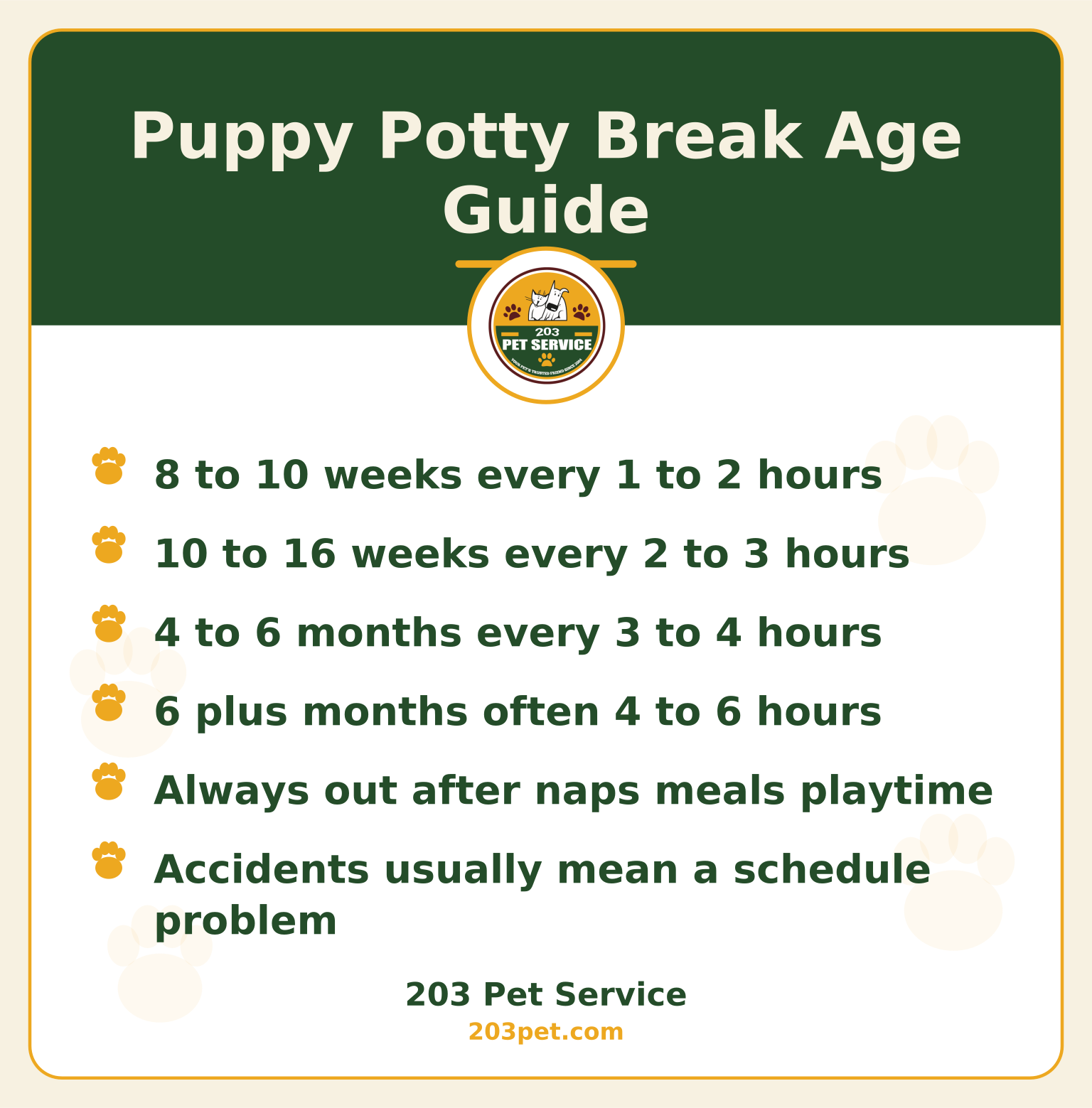
Most young puppies need a potty break at least every 2 to 4 hours while they are awake. Very young pups, 8 to 12 weeks, often need to go even more often, especially after sleeping, playing, or eating.
You may have heard “one hour per month of age.” That is a rough idea, not a promise. A 3 month old puppy is not guaranteed to hold it 3 hours. Some can. Many can't, especially in a busy home.
Age guideline for daytime potty breaks
Use this as a starting point, then adjust to your dog.
- 8-10 weeks: Every 1-2 hours while awake, plus after every nap, meal, and play session.
- 10-16 weeks: Every 2-3 hours while awake, plus after naps, meals, and play.
- 4-6 months: Every 3-4 hours while awake. Many can wait a bit longer if they are resting quietly.
- 6+ months: Many dogs can reach 4-6 hours in the day, though that doesn't mean they should do that every day.
The AKC training timeline notes that young puppies have limited physical control and need frequent chances to go in the right place.AKC puppy training timeline So if your new 9 week old Lab in Fairfield has accidents when left from 8 to 1, that's not a “bad” puppy. That is a schedule problem.
Signs your puppy needs a potty break now
Watch your puppy more than the clock. Common early warning signs include:
- Sudden sniffing in small circles.
- Wandering off to a quiet corner or behind furniture.
- Stopping mid-play and looking unsettled.
- Heading to the door or the room where the door lives.
If you see any of these, clip the leash and go. Do not wait and see. Fast action prevents accidents and teaches your dog that heading toward the door works.
Why feeding and water timing matters
Regular feeding and water access help you predict potty needs. Free feeding, where food is out all day, makes timing harder. The AKC recommends set mealtimes for puppies instead of leaving food down, which also supports good house training.AKC preparing for a new puppy
You should not water-restrict during the day, especially for growing puppies, but you can:
- Pick up water 1-2 hours before bedtime, after a last good drink.
- Offer water right after active play, then watch for a potty need shortly after.
- Avoid salty human foods, which can increase thirst and accidents.AKC human foods and dogs
Steady, predictable intake makes output more predictable. That makes your life easier on busy weekdays in Fairfield County.
How can you handle nighttime puppy potty breaks without losing all your sleep?

You handle night potty breaks by planning for 1-2 quick trips, setting up the crate near where you sleep, and staying boring so your puppy goes back to sleep fast.
Most young puppies can't sleep a full 7-8 hours without a bathroom break. Expect some interrupted sleep for the first few weeks. If you plan for that instead of hoping to “get lucky,” it feels a lot less frustrating.
Realistic night expectations by age
- 8-10 weeks: Often need 1-2 potty trips between bedtime and morning.
- 10-16 weeks: Many can sleep 5-6 hours, sometimes with one quick trip in the middle.
- 4-6 months: Many can start sleeping through the night, especially with smart water timing.
Every puppy is different. Small breeds often need more frequent breaks at first because of their smaller bladders.Merck Veterinary Manual on dog size
Keep night potty trips boring and short
Your goal at 2 am is not training. It is to get out, pee or poop, and get everyone back to sleep.
- Use a soft “let’s go outside” or similar phrase when the puppy stirs.
- Clip the leash on in the bedroom if you can.
- Go to the same spot.
- Say your cue once, then stay quiet and calm.
- Praise softly when they go, then straight back inside and into the crate.
No play. No zoomies in the living room. No late night TV. If you keep the energy low, most puppies in a week or two will pee, then settle back quickly.
Setting up the sleep space
The AKC crate training guide recommends placing the crate in or near your bedroom at first so you can hear your puppy and respond before they soil the crate.AKC crate training guide That advice lines up with what I have seen in homes in Fairfield County for years.
When the crate is close by, you can tell the difference between “I am bored” and “I really need to go.” If you wait until your puppy screams from another floor, they may already have had an accident.
Handling middle-of-the-night whining
Night whining can mean a lot of things. Quick rule of thumb:
- If it has been several hours since the last potty trip, take them out calmly.
- If you just went out 30 minutes ago and they are clearly awake and playful, wait quietly for a few minutes. Many will resettle.
- If whining is constant, check with your veterinarian to rule out medical issues.
Puppies are not trying to “test” you. they're small, growing animals with small bladders and new routines. Patience here pays off with a dog that is clean in your house for the next 10-15 years.
How do crates, pens, and safe spaces actually prevent puppy accidents?

Crates and pens prevent accidents by limiting where your puppy can wander when you're not watching. Puppies are far more likely to pee in a random corner of the dining room than in a small, comfy den space that feels like a bed.
When used properly, crates are not “doggy jail.” they're baby gates for your whole house packed into one safe, cozy space.
Crate basics backed by training science
Dogs are naturally less likely to soil the place they sleep. Good crate training uses that instinct without scaring or forcing the puppy. The AKC crate training steps focus on pairing the crate with food, toys, and calm time so the dog feels safe there.AKC crate training steps
Key points that matter for house training:
- The crate should be just big enough for your puppy to stand up, turn around, and lie down comfortably.
- If you bought a large adult-size crate, use a divider panel while they grow.
- Do not use pee pads inside the crate. That tells your puppy that their bed and bathroom are the same thing.
If a puppy is routinely peeing in the crate, something is wrong: the crate is too big, they are in it too long, or there's a medical issue that your veterinarian should check.
How to use pens and gates on busy evenings
In many homes in Bridgeport or Fairfield, the toughest time of day is that 5-8 pm window. Homework. Dinner. Sports gear everywhere. that's when a puppy will quietly wander off and leave a puddle behind the couch.
A simple answer is a playpen or a gated area that connects.
- Crate for naps and quiet time.
- Pen area for awake-but-contained time with toys, where you can still see them.
- Leashed “shadowing” time, where the puppy is on leash with you while you cook or fold laundry.
Everywhere your puppy has access should be within your line of sight. If you can't watch, they go in the crate or pen. This one rule alone keeps a lot of accidents from happening.
Safe spaces help with more than house training
Good crate and confinement training also helps puppies feel safer during storms, vet visits, and travel. VCA notes that early, positive confinement and social learning reduce fear later in life.VCA socialization and fear prevention
Think of a crate like a car seat for a baby. You do not rely on it forever. But while they're young, it keeps them safe while their brain and body grow.
Watch a crate training demo
If you're more of a visual learner, this short AKC video gives a clear, kind crate training example that lines up with what we teach in our puppy sessions in Fairfield County.
Video: The American Kennel Club shows how to introduce your dog to the crate using calm, positive steps.
If you want help setting this up in your own home, our W-2 employees can pair weekday puppy visits with crate practice so your dog’s house training stays on track while you work. You can read more about Jason’s training background on our about page.
What should you do about puppy house training when you have to be at work?

If you work outside the home, your puppy will need a trusted adult to give them at least one midday potty break, sometimes two, depending on age. Leaving a 10 week old puppy alone from 8 to 4 almost guarantees accidents and can slow house training by weeks.
In real life in Fairfield County, that usually means either a neighbor you fully trust, a family member, or a professional dog walker who understands puppy development.
Why long weekday gaps cause house training problems
Young puppies simply can't hold it for a full workday. When you routinely ask for 7-9 hours, one of two things happens:
- The puppy soils the crate or pen and starts to think that is normal.
- You come home to pee and poop in the house or on pads instead of outside.
Once a dog learns to lie near their own waste, it can take much longer to build clean habits later. The AKC stresses giving puppies frequent chances to go outside where you want them to eliminate.AKC house training advice
How a weekday walking membership helps house training
For many families in Fairfield, Stratford, or Westport, the answer is an ongoing weekday walking membership, not random one-off visits.
With a regular schedule, your puppy learns:
- Someone comes at the same general time every day.
- They get let out of the crate to go potty outside.
- They get a short walk, sniff time, and some gentle interaction.
- They go back to rest until you get home.
This rhythm takes pressure off the early morning and late evening windows too. Your puppy is not holding their bladder from 7 am to 1 pm. So they arrive at the afternoon calmer and less desperate.
We structure our dog walking services this way on purpose. Our walkers are W-2 employees, not gig workers bouncing between apps. They follow clear house training instructions set by Jason, an ABC certified dog trainer, and they share simple reports so you know when your puppy pees, poops, and how they are doing.
Safety, emergencies, and medical support
Puppies can sometimes get diarrhea or urinary tract infections, even when you do everything right. As a former veterinary technician, I can say this is not rare.
Our emergency protocol is simple and strict:
- If a puppy has an emergency on a visit, the salaried employee calls Robyn in our office right away.
- Robyn calls you to explain what's happening and discuss next steps.
- The walker or sitter stays with your pet until you tell us what your veterinarian recommends.
For serious issues, many of our clients use MedVet Norwalk for emergency care. We also work with local practices such as Greenfield Animal Hospital in Fairfield, where I worked as a veterinary technician in the past, and VCA Shoreline Animal Hospital in Shelton, and we understand how to follow veterinary instructions for diarrhea, urinary issues, and other problems that affect house training.
If you want help building workday potty breaks into your puppy’s routine, you can look over our pricing and then reach out through our contact page. We focus our full services in Fairfield, Stratford, Westport, Easton, Southport, Black Rock, and Bridgeport, with limited coverage in nearby towns like Shelton, Devon, Trumbull, Weston, and Wilton.
Frequently Asked Questions

About This Topic
How often should I take my new puppy out if I work?
Most young puppies need a potty break every 2 or 3 hours during the day. If you’re gone longer than that, plan for help, like a trusted neighbor, family member, or a professional midday visit. 203 Pet Service can build a realistic schedule around your exact commute and stop by for guaranteed bathroom breaks.
What’s a realistic weekday potty schedule for a puppy with school runs?
Tie bathroom trips to things you always do: wake up, breakfast, leaving the house, after school pickup, dinner, and bedtime. For many families, that looks like: out right after waking, 10, 15 minutes after meals, before you leave, as soon as you get home, and one last trip before bed. 203 Pet Service can tweak this around your exact school and work times.
Can I still crate train my puppy if I’m gone all day?
You can, but you’ll need planned breaks so your puppy isn’t forced to hold it too long. Crate time should match their age and bladder capacity, not your full workday. Many Fairfield County families combine a crate with a midday visit from 203 Pet Service so the puppy can potty and play, then settle again.
What should I do with my puppy when I can’t watch them?
Use a crate or small puppy-safe pen so accidents don’t become a habit. Give a potty break first, then a stuffed Kong or safe chew so they can relax. When you’re truly swamped, Zoom calls, school runs, late meetings, 203 Pet Service can step in with walks or playtime so your puppy still gets out on schedule.
How do I handle puppy potty training during a long Metro-North commute?
Build your puppy’s schedule around your actual train times: out right when you wake up, again after breakfast, right before you leave, and immediately when you walk back in. For the long gap in the middle, arrange a dependable midday break. 203 Pet Service regularly helps commuting owners in Fairfield County cover that critical middle-of-the-day outing.
My family’s busy and inconsistent, how do we keep puppy potty training on track?
Pick a simple pattern everyone can remember: out after sleeping, eating, playing, and anytime your puppy comes out of the crate. Post the schedule on the fridge and assign specific times to each family member so nothing’s missed. If there are gaps no one can cover, 203 Pet Service can plug those holes with planned visits.
About 203 Pet Service
What areas does 203 Pet Service cover in Fairfield County?
We provide professional dog walking, pet sitting, and training services across Eastern Fairfield County, Connecticut. We proudly serve families in Fairfield, Stratford, Westport, Easton, Southport, Black Rock, Bridgeport, Shelton, Devon, Trumbull, Weston, and Wilton. 203 Pet Service has cared for pets in Fairfield County since 2004, and every visit is handled by a trained, W-2 salaried employee who is background checked and fully insured.
Why does 203 Pet Service use salaried W-2 employees instead of independent contractors?
We believe salaried W-2 employees provide more reliable, accountable, and professional pet care. Unlike independent contractors, our salaried employees go through careful background checks, full training, and are fully insured. This employment structure means consistency, accountability, and peace of mind for Fairfield County pet families.
What qualifications do 203 Pet Service employees have?
Every member of our salaried W-2 team goes through careful background checks, professional pet care training, and ongoing education in animal behavior and safety. Owner Jason Hofmann personally trains each employee, drawing on 29 years as a veterinary technician, pet store manager, and ABC-certified dog trainer. We don't hire hobby pet sitters. We employ career pet care professionals.
What makes 203 Pet Service different from other pet sitters in Connecticut?
Our owner, Jason Hofmann, brings 29 years of professional pet care experience, including 5 years as a veterinary technician at Greenfield Animal Hospital in Fairfield. As an Animal Behavior College (ABC) certified dog trainer, Jason built 203 Pet Service on veterinary medical knowledge and professional training, not just hobby experience. Plus, we have served Fairfield County families since 2004 with the same care for safety and reliability.