

Loose Leash Walking: Simple Steps for Calmer Dog Walks
Quick Answer: Loose leash walking means your dog can move beside you on a relaxed leash instead of dragging you down the street. It is a skill any healthy dog can learn. Start in a quiet area, reward your dog often for staying near you, keep sessions short, and use the right gear so walks around Eastern Fairfield County feel calm, safe, and fun again. If your dog drags you to the end of the sidewalk before you even take three steps, you are not alone. Loose leash walking is a skill, not a personality trait, and most dogs are never really taught how to do it. With a few simple habits and the right practice, your walks in Eastern Fairfield County can feel calm, easy, and safe instead of like a daily tug-of-war.
I have been walking and training dogs in Fairfield County since 2004. I can tell you this with confidence: any reasonably healthy dog can improve on leash. Your dog may never march like a show dog, but you absolutely can get to “no more arm-socket damage” walks.
Let’s talk about how. Why does loose leash walking matter for you and your dog?

Loose leash walking matters because it keeps both you and your dog safer and calmer. A dog who pulls less can handle busy streets, other dogs, and surprise noises without turning every walk into a wrestling match.
In plain terms, constant pulling is stressful. Your shoulder hurts, your back tightens up, and you start dreading walks. Your dog is not having a great time either. Many dogs that drag on leash stay overexcited from start to finish, which actually makes it harder for them to sniff, explore, and relax in a healthy way.
Regular walks are also a big part of your dog’s physical and mental health. The American Kennel Club explains that different breeds need different levels of exercise, but most dogs need daily movement and mental stimulation to stay balanced. If you avoid walks because of pulling, your dog misses that outlet. That is when you see more barking, chewing, and pacing at home.
Now layer safety on top of this. In Fairfield County we walk near busy roads like Kings Highway in Fairfield, Barnum Avenue in Stratford, and the Post Road through Westport and Bridgeport. A dog that lunges suddenly at a squirrel or another dog near traffic can pull you off the curb or slip a collar. That is how accidents happen.
Veterinary groups like VCA Animal Hospitals point out that solid leash control is a key part of walking safety, right along with ID tags and choosing safe routes. Good leash behavior is not just polite. It is a safety skill.
There is also a nice side effect. Dogs that learn to walk on a loose leash often get calmer in other parts of life. Structured walks teach patience, impulse control, and how to check in with you. All of that carries over when guests ring the doorbell or when you sit down to eat dinner and your dog usually begs.
I have seen this again and again with our weekday dog walking clients in Southport and Easton. Once their dog stops dragging on walks, they also jump less, bark less, and settle faster at home. One skill changes a lot of things. How do you pick the right leash and collar before you train?

To set your dog up for loose leash walking, you need a simple, well fitted collar or harness and a plain leash. The gear should make it easy for your dog to understand you, not scare or hurt them.
For most dogs, I like a basic six-foot nylon or leather leash. No bungees. No extra clips. Just a solid leash you can hold easily. Shorter than six feet feels tight and longer gets messy for training. A standard leash also keeps your dog at a safer distance near cars, bikes, and driveways, which matters on narrow streets in neighborhoods from Black Rock to Weston.
Retractable leashes cause a lot of pulling problems. They teach dogs that walking forward and leaning into pressure makes the leash go longer. That is the opposite of what we want. Retractables also tangle around your legs, poles, and strollers. Many vets and trainers recommend avoiding them, especially for training, because of burn injuries and sudden jerks to the neck and spine if the leash locks fast. The PetMD dog walking guide also notes that fixed-length leashes give much better control.
For what goes on your dog, you have a few choices: Flat buckle collar for dogs that already walk fairly nicely and do not slip collars. Front-clip harness for dogs that pull hard or have shorter noses, like pugs and Frenchies. Back-clip harness for dogs that do not pull much or have skin or neck issues.
A good harness should not rub under the armpits or gape so much that your dog can back out of it. You want snug but comfortable. The Merck Veterinary Manual explains how body shape and weight vary by breed, and that matters for fit. A harness that works for a slim sighthound is not right for a broad chested bully breed.
Skip prong collars, choke chains, and any tool that relies on pain or fear. They might stop pulling in the short term, but they can create neck damage and behavior fallout, especially around other dogs and people.UC Davis Veterinary Medicine reminds owners that training tools should be used in ways that protect long term health and comfort. Pain is not needed for leash training.
If you are not sure what fits your dog best, this is exactly the kind of question we go over during our weekday walk set up for new 203 Pet Service clients in Southport and Black Rock. A quick look at your dog’s build and history usually points us in the right direction. What is positive reinforcement and how does it fix pulling?

Positive reinforcement means you pay your dog when they do something you like. For leash walking, that means you reward your dog any time the leash is loose or they choose to walk near you.
Most dogs pull because pulling works. They see a tree or another dog, they lean into the leash, and they get to sniff or say hi. That reward teaches them to pull more. We flip that script. We teach your dog that staying near you and keeping slack in the leash is what makes good stuff happen.
The AKC crate training guide explains this same idea in a different context. Puppies learn to love their crate when we pair it with treats, toys, and calm praise. Leash skills work the same way. Dogs repeat what we reward.
So what do you use as a reward on walks?
- Small treats your dog loves and can eat quickly, pea size or smaller.
- Sniff breaks where you say “go sniff” and let them explore a bush or tree.
- Short jogs or play for dogs that find movement more exciting than food.
Food rewards are easiest, especially at first. Just keep in mind that some human foods are not safe for dogs. The AKC list of safe human foods for dogs is a handy reference. If you use little bits of chicken or cheese, keep them plain and avoid anything seasoned with onions, garlic, or artificial sweeteners like xylitol.
Timing is key. You want your dog to know exactly which behavior you are paying for. If your dog walks next to you for two seconds, then for three seconds, that is the moment to quietly praise and pop a treat right by your leg. If you wait until they are already lunging at a squirrel, the reward goes to the wrong behavior.
Think of your timing like snapping a photo. You are trying to “take a picture” of your favorite moment. Leash is loose. Dog is near your hip or glancing up at you. Click. Treat. Repeat. That is how we build a new habit.
In my dog training sessions and our weekday loose leash dog training programs in Bridgeport and nearby towns like Trumbull and Wilton, this is where most people need coaching. Once the timing improves, the dog usually improves right behind it. How do you teach loose leash walking on your own block?
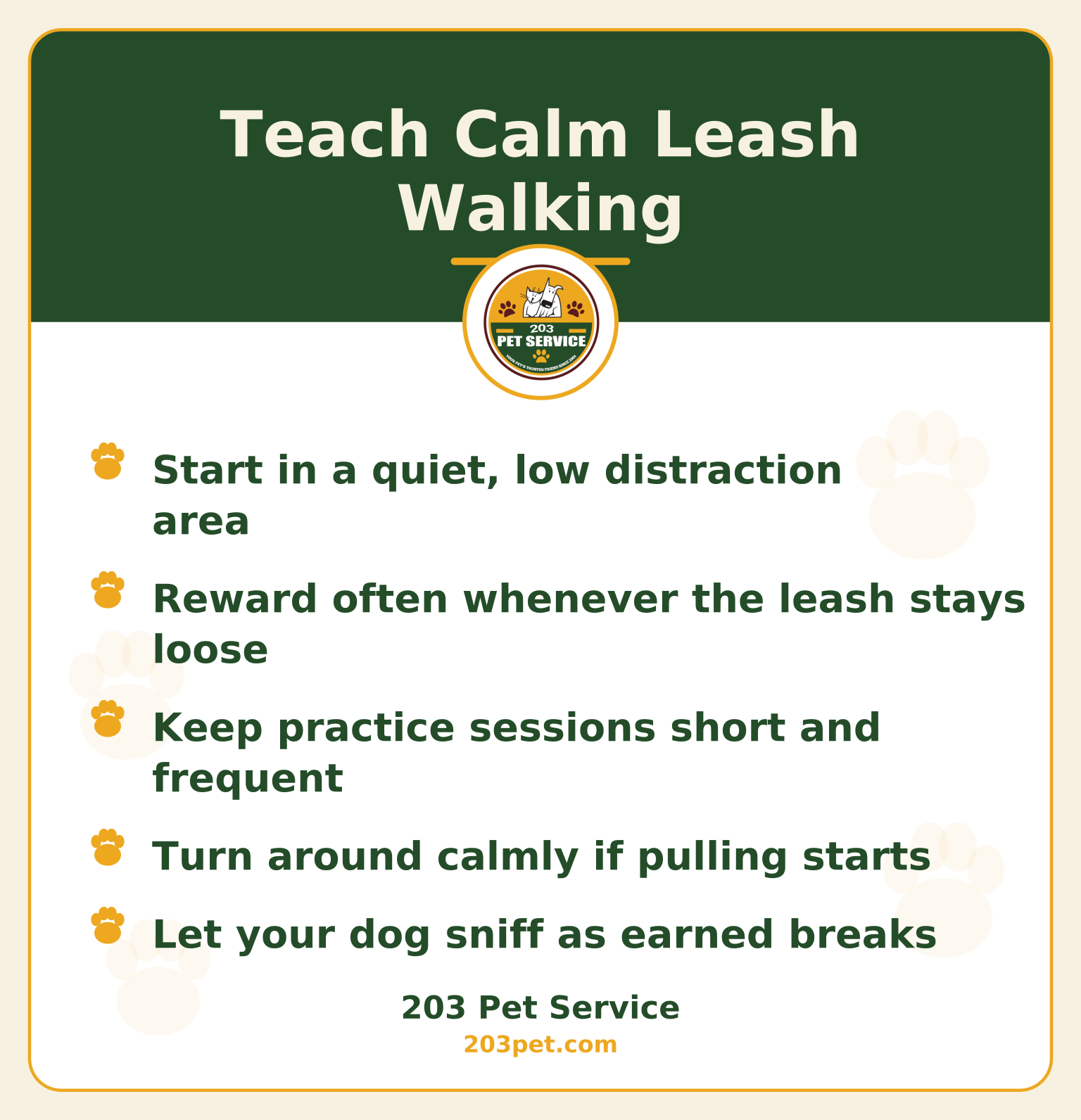
You teach loose leash walking by starting in a quiet place, paying your dog often for staying close, and calmly stopping or changing direction any time the leash gets tight. Short, easy sessions work better than one long battle.
Start where your dog can think
If your dog goes nuts the second you hit the sidewalk on North Avenue in Fairfield or Main Street in Stratford, do not start there. Start in your yard, your driveway, or even inside your house. You want a low distraction space where your dog can notice you.
Clip on the leash. Have a handful of treats in your pocket or treat pouch. Take two steps. If the leash is still loose and your dog is roughly beside you, say “yes” or “good” and hand over a treat right by your leg. Turn and take a few steps the other way. Reward again if the leash is slack.
At first you might only walk little zigzags in the driveway in Easton or a hallway inside your condo in Black Rock. That is fine. You are teaching a new language.
The stop and wait method when the leash gets tight
Next rule is simple. Tight leash means we stop. Every time.
Walk forward at a normal pace. The second your dog starts to pull and the leash goes tight, just stop. Plant your feet. Do not yank your dog back. Do not repeat their name fifteen times. Just hold the leash and wait.
Most dogs will do one of three things. They will dig harder, they will look back at you, or they will wander back within a couple seconds when they realize you are not coming. The moment your dog turns back or even softens the tension, say “yes” and reward near your leg. Then walk forward again.
This is boring work. It is also very clear for your dog. Pulling no longer works. Loose leash does.
The PetMD guide on dog walking talks about how consistent rules help dogs learn faster. If pulling works sometimes and not others, your dog will keep trying it. If pulling never works, most dogs give up that habit much sooner.
Play the “change direction” game Another trick I use a lot on the sidewalks in Westport and Shelton is the “change direction” game. It keeps your dog guessing in a fun way and teaches them to check in with you more often.
Start walking in a straight line. After four or five steps, say “this way” in a cheerful voice and turn 90 or 180 degrees. As your dog turns to follow you, mark it with “yes” and give a treat by your leg. Walk another few steps and change direction again.
You might feel a little silly doing this on your block. That is ok. Your dog will quickly learn that it pays to keep an eye on you, not just the horizon. They cannot blast to the end of the leash if they never quite know when you might change direction.
Keep sessions short and end on a win
Loose leash training works best in short bursts. Ten minutes in your yard. Five minutes on a quiet side street. Then you can switch to a more casual walk where you loosen the rules a bit and let your dog sniff more.
Dogs, like people, learn better when they are not exhausted or frustrated. The AKC puppy prep guide reminds new owners to keep training sessions short and upbeat, because puppies tire out fast. Adult dogs may have more stamina, but their brains still hit a limit.
End your training on an easy success. Two or three nice steps by your side, treat, and go back inside. If you push until your dog is checked out, you both end up cranky and less eager to try again tomorrow.
This is where having regular weekday walks with consistent rules makes a big difference. Our salaried W-2 employees at 203 Pet Service walk dogs in Fairfield, Stratford, Westport, Easton, Southport, Black Rock, and Bridgeport using the same loose leash habits you are practicing at home. Repetition from multiple people speeds things up. Video: Loose leash walking with an untrained dog, showing real-time handling, timing, and reward placement during a neighborhood walk. How do you handle squirrels, other dogs, and kids on bikes?

You handle real life triggers by creating space early, asking for a simple behavior like “watch me,” and rewarding your dog for checking in with you. If your dog is already lunging and barking, you move away first, then regroup.
Make space before your dog explodes
In Fairfield County, there is always something happening on the sidewalks. Squirrels on the Green in Fairfield. Kids on scooters in Bridgeport. Dogs walking past the beach in Westport. If you wait until your dog is at the end of the leash, you are already late.
As soon as you spot a trigger that usually sets your dog off, take a breath and do three things:
- Create more distance. Cross the street if you can. Move into a driveway. Step behind a parked car.
- Talk to your dog before they lock in. Say their name once in a friendly tone.
- Start feeding tiny treats one after another while you pass the trigger.
This steady stream of treats is called “rapid fire” or “treat and go.” You are not rewarding fear or excitement. You are pairing the sight of a trigger with “my human feeds me and we keep moving.” Over time, many dogs stop reacting so hard, because the trigger predicts something good and normal instead of chaos.
UC Davis notes that early, consistent behavior work helps many dogs feel safer around triggers instead of stuck in a pattern of fear or frustration.Their animal health library often refers to this kind of pairing as part of behavior modification plans.
Teach a simple “watch me” cue
A “watch me” or “look” cue is a nice tool for busy sidewalks in places like Devon or Shelton. It just means “eyes on me for one second.” That is it.
Start at home. Hold a treat near your dog’s nose, then slowly lift it up to your eyes. The moment your dog’s eyes meet yours, say “yes” and give the treat. After a few reps, add the word “watch” or “look” right before you lift your hand.
Once your dog understands that “watch” means eye contact, you can use it outside. See a bike coming up behind you on Park Avenue in Bridgeport. Step to the side. Say “watch.” Reward your dog for one second of eye contact while the bike passes. Then release them to sniff again.
What if your dog is already at the end of the leash barking?
If your dog is over threshold, meaning they are lunging, barking, and cannot take treats, your first job is to leave. Do not worry about training in that moment. Just get out of there safely.
Turn and walk away, even if it means ducking down a side street or circling behind a building. When your dog can eat a treat again and their body softens, then you can practice from a distance.
In those heated moments, safety comes first. Hold the leash with both hands if you need to. If your dog slips a collar or you fall, things can escalate fast near busy roads. The VCA walking safety guidelines suggest planning routes with escape options, like side streets and open parking lots, so you are not stuck pressed against traffic with no way out.
Frequently Asked Questions

About This Topic
How do I stop my dog from dragging me down the street?
Start in a quiet area like your yard or hallway and reward your dog every time the leash stays loose beside you. Take a few steps, mark the good behavior with “yes!” and give a treat by your leg. If they pull, calmly stop or turn around instead of yanking. 203 Pet Service can also walk and train your dog around Eastern Fairfield County to reinforce this.
What’s the best way to teach loose leash walking from scratch?
Begin indoors or in a low-distraction area, using tiny, frequent rewards whenever your dog is near your side with a relaxed leash. Keep sessions short, 2, 5 minutes, and quit before your dog gets frustrated. Practice a few times a day, not just on full walks. If you’re in Fairfield County, 203 Pet Service can set up a simple, step‑by‑step training plan for you.
How long does it usually take to fix my dog’s pulling?
Most dogs show improvement in a week or two if you’re consistent, but truly solid loose leash walking can take several weeks of daily practice. Younger, high-energy dogs may need more time and shorter, more frequent sessions. The key is repetition in different places. 203 Pet Service can help speed that up with professional walking and training support.
What leash and collar should I use for a strong pulling dog?
Use a sturdy 4 to 6 foot leash and skip retractable leashes while you’re training. A well fitted front clip harness often gives you more control without causing pain, especially for large or strong dogs. Avoid tools that rely on choking or pain; they can make pulling and reactivity worse. 203 Pet Service can recommend and fit appropriate gear during a training visit.
My dog pulls like crazy near busy Fairfield County roads, help?
First, practice loose leash walking in quiet spots before tackling places like Kings Highway or Barnum Avenue. Gradually move closer to busier areas, rewarding your dog for checking in with you and keeping the leash slack. Keep sessions short and end on a win. If local walks feel overwhelming, 203 Pet Service can work with your dog directly in your Fairfield County neighborhood.
Is my dog too old or too stubborn to learn loose leash walking?
Age and personality matter less than consistency and clear training. Most reasonably healthy dogs, even seniors and “stubborn” breeds, can learn to walk on a looser leash when you reward small improvements and don’t let pulling “work” for them. You may just need shorter sessions and softer treats for older dogs. 203 Pet Service has been helping Fairfield County dogs of all ages improve since 2004.
About 203 Pet Service
What areas does 203 Pet Service cover in Fairfield County?
We provide professional dog walking, pet sitting, and training services across Eastern Fairfield County, Connecticut. We proudly serve families in Fairfield, Stratford, Westport, Easton, Southport, Black Rock, Bridgeport, Shelton, Devon, Trumbull, Weston, and Wilton. 203 Pet Service has cared for pets in Fairfield County since 2004, and every visit is handled by a trained, W-2 salaried employee who is background checked and fully insured.
Why does 203 Pet Service use salaried W-2 employees instead of independent contractors?
We believe salaried W-2 employees provide more reliable, accountable, and professional pet care. Unlike independent contractors, our salaried employees go through careful background checks, full training, and are fully insured. This employment structure means consistency, accountability, and peace of mind for Fairfield County pet families.
What qualifications do 203 Pet Service employees have?
Every member of our salaried W-2 team goes through careful background checks, professional pet care training, and ongoing education in animal behavior and safety. Owner Jason Hofmann personally trains each employee, drawing on 29 years as a veterinary technician, pet store manager, and ABC-certified dog trainer. We do not hire hobby pet sitters. We employ career pet care professionals.

What Fairfield County Families Say About 203 Pet Service
Don't just take our word for it. Here's what real families in your community have shared about their experience with us:
"Jason and his team have been caring for our senior golden retriever for 5 years. When we lost him last month, they were incredibly supportive. These aren't just dog walkers - they become part of your family."
— Sarah M., Westport CT (Google Review)
"The consistency of having the same walker every day made such a difference for our anxious rescue. When she passed, they sent the kindest card. 22 years in business for a reason."
— Michael K., Fairfield CT (Google Review)
"W-2 employees, background checked, insured - they do things the right way. Our cats have been with them for 3 years and we wouldn't trust anyone else."
— Jennifer L., Stratford CT (Facebook Review)
Read more reviews: Google Reviews | Facebook Reviews | Yelp Reviews
About Jason Hofmann
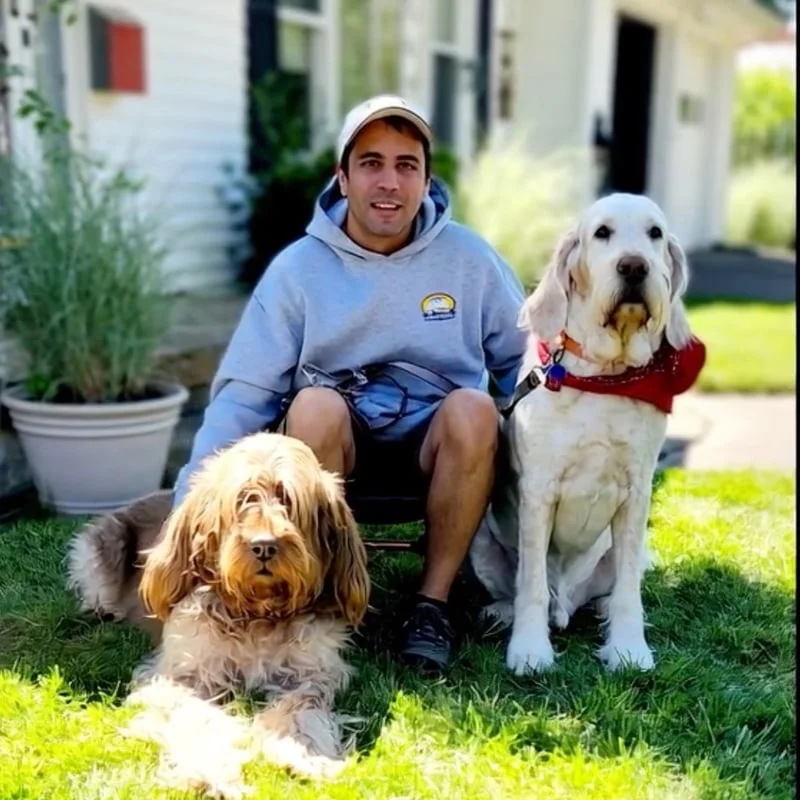
Jason Hofmann is the owner and Animal Behavior College (ABC) certified dog trainer at 203 Pet Service, with 29 years of professional pet care experience. He founded 203 Pet Service in 2004 and has led the company for 22 years, building a team of salaried W-2 employees dedicated to exceptional pet care. Prior to founding his company, Jason worked for 2 years as a pet store manager and then 5 years as a veterinary technician at Greenfield Animal Hospital in Fairfield. As an ABC certified trainer and passionate animal advocate with 29 years of hands-on experience, Jason brings unmatched expertise and genuine care to every pet interaction.
Jason is also a proud co-founder of The Honey On Duty Project, a 501(c)(3) nonprofit that brings healing and comfort to communities in need.
Learn More About Our TeamFeatured in the Media:
Why 29 Years of Professional Experience Matters
Growing up with pets or currently owning a dog doesn't make someone a pet care professional - just like using a toilet every day doesn't make you a qualified plumber.
Jason's 29 years of professional pet care experience means:
- •5 years working daily as a veterinary technician at a professional animal hospital
- •2 years managing a pet store and advising pet owners
- •22 years owning and operating a professional pet care business
- •Formal Animal Behavior College (ABC) certification in dog training
- •Thousands of hours of hands-on experience with diverse animal behaviors, medical situations, and emergency scenarios
This isn't hobby experience - it's a career built on professional training, veterinary medical knowledge, and decades of real-world problem-solving with animals.
Ready to Experience Professional Pet Care?
Schedule a meet and greet today and see the 203 Pet Service difference for yourself.