Welcome to 203 Pet Service. How can I help you and your pet today?
Pet Care
Fairfield County
Connecticut
Prepare Your Home for a Newly Adopted Dog in Eastern Fairfield
Jason Hofmann
September 23, 2026
15 min read
Share this article
Prepare Your Home for a Newly Adopted Dog in Eastern Fairfield
Quick Answer: Prepare your home for a newly adopted dog in Eastern Fairfield County by planning a quiet first day, setting up a safe space like a crate or gated room, and deciding on a simple routine for walks, meals, and potty breaks before they arrive. Then line up local help, such as a trusted dog walker, vet, and trainer in towns like Fairfield, Stratford, or Westport, so you are ready if you need backup.
Prepare Your Home for a Newly Adopted Dog in Eastern Fairfield
You prepare your home for a newly adopted dog in Eastern Fairfield by setting up a quiet first day, a safe space, a simple routine, and a local support team before your dog even walks through the door. When you do that, your new dog can start to relax instead of scrambling to survive another big change.
In our 22 years walking and caring for dogs in Fairfield, Stratford, Westport, Easton, Southport, Black Rock, and Bridgeport, we have seen the same thing over and over. The people who prepare well do not just have an easier first week. They usually end up with fewer behavior problems long term.
So let’s walk through what actually works for real homes in Eastern Fairfield County.
Why should the first day with your newly adopted dog be quiet instead of a big crowd?
The first day should be calm because your new dog is already flooded with new sights, smells, and sounds. A quiet house gives their brain a chance to catch up and feel safe, instead of forcing them to meet every friend, neighbor, and cousin in one afternoon.
Most rescue and mixed breed dogs have already gone through more change than we will ever know. Shelter, foster home, transport vans, strange dogs, new people. That all sits in their nervous system. The American Kennel Club points out that new dogs, like puppies, handle change better when they have a quiet, controlled start at home, not chaos on day one.
Who should be home on day one?
On the first day, keep it to the people who actually live in the house full time. If you share parenting, that means the adults who will handle most of the care, and the kids who live there.
Ask grandparents, friends, and the kid from down the street to wait a few days. You can say, “We want to give the dog a calm first day. We’ll schedule a visit after they settle.” Most people understand that.
If you live in a busy part of downtown Bridgeport or near the train in Southport, your dog is already getting a lot of stimulation just from the street noise. You do not need to add more inside the house that first night.
Set simple house rules everyone follows
Before the dog arrives, sit down with your family and write out three to five simple rules. Short and clear. For example:
We let the dog come to us. No hugging or grabbing.
No feeding from the table, ever.
The crate or bed is a “no bother” zone.
We always clip the leash before opening outside doors.
Kids usually do well when you give them a job. “Your job is to be the treat helper when we call the dog to us” works better than “do not chase the dog.”
If everyone in your Fairfield townhouse or your Stratford cape follows the same rules from the first day, your dog learns faster and feels safer. Dogs read patterns. Consistency matters more than perfection.
🐾 🐾 🐾 🐾 🐾 🐾 🐾 🐾
How do you set up a safe, cozy space before you bring your new dog home?
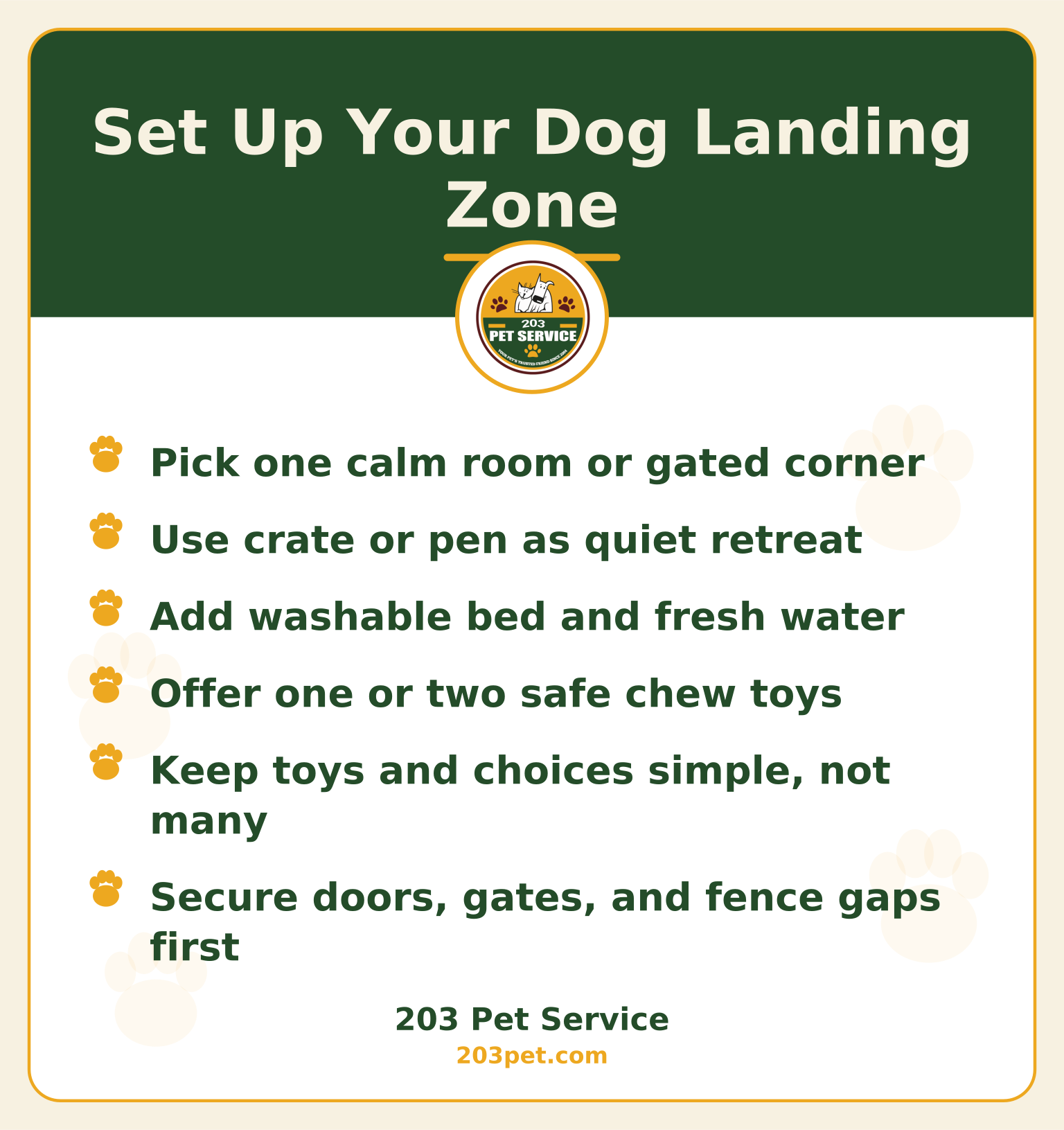
You set up a safe space by picking one calm area of your home and making it your dog’s “landing zone” for the first few days. Think of it like a studio apartment for your dog inside your larger house.
That might be a spare bedroom, a corner of the living room with a sturdy gate, or a crate with a playpen around it. The goal is simple. Your new dog has a place to retreat, rest, and observe you, without getting swarmed or lost.
Room, crate, or gated area: what works best?
If your home in Easton or Weston is spread out, a single room can work well. You can close the door, set up a crate, and let the dog decompress quietly.
If you live in an apartment in Black Rock or along the Post Road in Fairfield, you might not have a spare room. A crate plus a sturdy exercise pen can create a little “dog studio” in your living room.
Crate training, when you do it correctly, helps many dogs feel safer. The AKC shows how to make the crate a positive place with short, happy sessions and rewards, not long periods of isolation or punishment.[source]
Video: AKC trainers explain step-by-step crate training so your dog sees the crate as a safe den, not a punishment.
What should you put in your dog’s first safe zone?
Keep it simple for the first few days. In that space, set up:
A comfortable bed or mat that is easy to wash
Fresh water in a non-tip bowl
One or two safe chew items, like rubber or nylon chews
A couple of toys, not a huge pile
If you use a crate, soft bedding that your dog cannot easily shred
Avoid putting every new toy from Petco in there. Too many options can be overwhelming for a stressed dog. The Merck Veterinary Manual notes that dogs handle new environments better when they have predictable, simple surroundings and familiar scents.
Keeping exits secure in Fairfield County style homes and yards
Before your new dog arrives, walk your property with “dog escape” eyes. In older Fairfield County homes, I often see loose gate latches, gaps under fences, and screen doors that do not fully latch.
Check these spots:
Side doors that open right to a driveway
Basement bulkhead doors
Sloping yards in Trumbull or Shelton where the fence floats off the ground
Old deck stairs with missing slats
Fix what you can before the dog comes home. At least, use leashes and baby gates as backup. When we provide in-home pet sitting, our salaried W-2 employees always clip the leash before opening any exterior door. That simple habit has prevented more than a few “door dash” scares in Stratford and Bridgeport.
🐾 🐾 🐾 🐾 🐾 🐾 🐾 🐾
How do you pet proof your house and yard for a new dog the simple way?
You pet proof your house by removing or blocking things your dog can chew, swallow, or escape through, before they find those things for you. Think like a curious toddler with sharp teeth.
The AKC points out that puppies in particular will explore with their mouths, and new adult dogs are not that different when stress runs high.[source] You do not have to remodel your house. You just need to scan room by room.
Common indoor hazards to fix right away
Walk through each room and look for:
Loose electrical cords that cross the floor
Houseplants, since many common ones can upset stomachs or worse
Medications on low tables or counters
Trash cans without lids, especially in the bathroom and kitchen
Small toys, socks, or hair ties on the floor
Many human foods can also cause problems. Foods like grapes, chocolate, and xylitol sweetener are real risks. The AKC’s human foods list lays out what is safe and what is not. It is worth bookmarking.
New dogs often get upset stomachs in the first few days, just from stress and food changes. If you notice repeated vomiting, blood, or a very tired dog, call your vet. PetMD explains how to tell mild stomach upset from a more serious issue and when you should go in right away.
Doors, fences, and leash checks for local neighborhoods and parks
In places like Seaside Park in Bridgeport or trails in Wilton, I see the same safety problems repeat. Loose collars, retractable leashes in busy areas, and dogs that have not learned how to handle passing bikes or strollers.
The VCA dog walking safety tips recommend using sturdy, well-fitted equipment, being visible, and staying aware of your surroundings. That matters even more with a new dog who might dart at sudden noises or moving objects.
Before your first walk in your Fairfield County neighborhood: Check that your dog’s collar or harness fits snugly, you should not be able to pull it over the head
Use a 4 to 6 foot leash, not a retractable, especially near traffic
Clip an ID tag with your phone number on right away
Carry poop bags and a few treats for redirection
Our ongoing dog walking membership follows these same safety habits on every walk. We match dogs to regular walkers, so your dog builds a steady bond with one person, not a string of random gig workers.
Basic safety for kids, guests, and nervous new dogs
A nervous new dog, a crowded living room, and excited kids is a mix that can go sideways fast. Most bites come from dogs who feel trapped, not “mean” dogs. UC Davis notes that stress, pain, or fear often sit behind sudden behavior changes in animals.[source]
Simple safety rules help:
Adults manage all greetings for the first couple of weeks.
Teach kids to pet gently on the side of the dog’s neck or chest, never hug the dog.
If the dog walks away, everyone lets them. No chasing.
Guests ignore the dog at first. If the dog approaches, they can toss a treat onto the floor.
Think of it as teaching people “dog manners.” You are setting your dog up to succeed, not testing how much they will tolerate.
🐾 🐾 🐾 🐾 🐾 🐾 🐾 🐾
How do food, walks, and bathroom breaks help a rescue dog feel safe?
A steady schedule helps your new dog feel safe because dogs relax when they can predict what happens next. Food, walks, and bathroom breaks at roughly the same times each day tell your dog, “You are not on your own anymore. We have you.”
The Merck Veterinary Manual notes that routine care like regular feeding and exercise times supports both physical and mental health in dogs. That is not just theory. In our daily work in Fairfield County, we see anxious rescue dogs calm down when their people stick to a simple rhythm.
Sample daily schedule for Eastern Fairfield families who work
Every home is different, but many of our clients in Fairfield, Westport, and Bridgeport follow a version of this weekday plan:
6:30 - 7:00 am Wake up, quick potty trip, then breakfast in the safe zone.
7:30 - 8:00 am Short walk around the block, keep it calm and simple.
Midday A 20 to 30 minute walk, either by you if you work from home or through our dog walking membership if you commute.
Late afternoon Another potty break and some relaxed play or training games.
5:30 - 7:00 pm Dinner, then a stroll through the neighborhood.
Before bed Final potty break and quiet time.
If you work in New York and leave early from Easton or Devon, a midday walk is not a “nice extra.” For many dogs, especially younger ones, it is needed. The AKC’s exercise guide shows that most breeds need multiple short activity periods each day, not one long burst on weekends.
How to handle alone time in small steps
Separation can be hard on rescue dogs. Some panic if you even leave the room. Others look fine for 10 minutes, then melt down when you are gone for an hour.
Start with tiny absences:
Put your dog in their safe space with a chew.
Walk out of the room for 1 to 2 minutes, then come back casually.
Do not throw a party when you return. Act normal.
Gradually stretch the time to 10, 15, then 30 minutes over a few days.
If you know you have a long workday coming and your dog is not ready, do not wing it. Use support. Professional in-home pet sitting or ongoing walks break up the day so your dog is not alone for 8 to 10 hours in a strange house.
At 203 Pet Service, our salaried W-2 employees build long term relationships with the dogs they walk and sit. That matters for separation issues. Your dog learns, “Oh, this is my regular walker, not a stranger,” which lowers the stress of you leaving.
🐾 🐾 🐾 🐾 🐾 🐾 🐾 🐾
What should you do for the first vet visit and local support team?
You set your dog up well by gathering records from the shelter, booking a vet visit within the first week or two, and lining up a local support circle of a trainer, walker, and sitter. That way you are not scrambling in your first emergency or behavior hiccup.
What records should you ask the rescue or shelter for?
Before you leave the shelter or rescue parking lot, make sure you have:
Vaccination history with dates and the vet’s name
Spay or neuter records, or a note if it is not done yet
Any known medical conditions or medications
Microchip number and the company name
Any behavior notes from foster homes
For puppies, vaccines matter a lot. The AKC puppy shot schedule explains which shots pups normally get at each age. Even if you adopt an adult dog, your vet will want to know what vaccines they already had.
Questions to ask your vet in the first visit
In Fairfield County we are lucky to have strong veterinary care, from Greenfield Animal Hospital in Fairfield to VCA Shoreline Animal Hospital on Bridgeport Avenue in Shelton and MedVet Norwalk for emergencies.
In your first vet visit, ask:
Is my dog at a healthy weight for their body type?
What food do you recommend for this age and activity level?
Any concerns you see in teeth, skin, or joints?
What parasite prevention should we use in this area?
What signs mean I should call you right away?
The VCA guide on dental disease shows how common dental issues are in adult dogs and how they affect overall health. It never hurts to ask your vet where your new dog stands.
Since our owner, Jason, spent five years as a veterinary technician, we also talk with clients about practical first aid. The AKC first aid guide explains what you can safely handle at home and when you need to get to MedVet or another emergency hospital fast.
Building your local support circle
Think of your support circle as your dog’s “village” in Eastern Fairfield County. At minimum, you want:
A primary vet you trust and can reach
A trainer who uses kind, evidence-based methods
A fully insured dog walker for steady weekly walks
A sitter for vacations, work trips, and long days
We work closely with local vets and trainers to keep care consistent. If you are not sure where to start, our About page explains Jason’s training background and how our salaried W-2 employees handle walks, pet sitting, and dog training as a real profession, not a side gig.
You do not have to build this circle in one week. But the sooner you know who you would call for training, pet sitting, or a midday walk in Fairfield or Stratford, the better you will sleep.
🐾 🐾 🐾 🐾 🐾 🐾 🐾 🐾
How can you gently build trust with your new dog in the first weeks?
You build trust by going at your dog’s pace, pairing yourself with good things, and not asking for too much too fast. Respect the dog’s “no” when they turn away or look tense.
Trust shows up in small moments. A dog who chooses to lie near you. One who follows you to the kitchen, tail loose, just to see what you are doing. That only happens when they feel safe.
Reading body language and pressure points
Watch your dog’s face and body. Common signs of stress include:
Yawning when they are not tired
Licking lips over and over
Turning the head away
Whale eye, where you see the whites of the eyes
Stiff body, closed mouth, ears pinned back
Tail tucked or held very low
How should I set up my home before bringing a rescue dog?
Pick one quiet room as your dog’s landing zone and set up a crate or gated area with a bed, water, and a few toys. Decide on a simple routine for walks, meals, and potty breaks before they arrive. Put trash, shoes, kids’ toys, and cables out of reach. If you’re in Eastern Fairfield County, 203 Pet Service can help reinforce that new routine with consistent walks.
What should the very first day with my newly adopted dog look like?
Keep day one calm: only household members, no big welcome party, and no trips to busy stores. Give short walks, lots of quiet time, and let your dog explore one area at a time. Stick to a predictable feed, walk, rest rhythm. If you’ll need help midweek, schedule a meet-and-greet with 203 Pet Service in Fairfield County ahead of time.
How often should I walk a new rescue dog the first week?
Most new dogs do best with 3 to 4 short walks spread through the day, plus a final bedtime potty break. Keep walks low-stimulation at first, quiet streets instead of crowded downtown areas. As they relax, you can go farther. If your schedule’s tight in towns like Fairfield or Stratford, a 203 Pet Service dog walker can fill the gaps.
My new dog seems shut down and scared, should I worry yet?
It’s normal for a newly adopted dog to be nervous, sleepy, or withdrawn for several days while they process all the changes. Give them a predictable routine, a safe space, and don’t push cuddles or introductions. If fear isn’t improving after a couple of weeks, loop in your vet and a positive trainer. 203 Pet Service can also provide calm, consistent care that builds trust.
When is the right time to introduce my new dog to visitors?
Wait at least a few days, sometimes a couple of weeks, until your dog is eating, sleeping, and going potty on a routine. Start with one calm visitor at a time, on leash if needed, and let your dog choose how close to get. Avoid kids rushing in for hugs. If you’re unsure, ask your trainer or 203 Pet Service walker to model low-key greetings.
Do I really need a crate or gated room for my adopted dog?
You don’t have to use a crate, but a defined, safe area makes the transition much easier. It prevents accidents, chewing, and panic while your dog learns the house rules. Many dogs relax faster when they have a cozy, quiet den of their own. 203 Pet Service staff are used to working with crated and gated setups and can help keep that routine consistent.
What local support should I line up before my new dog comes home?
Before adoption day, pick a local vet, a positive reinforcement trainer, and a reliable dog-walking or pet-sitting service. Save their numbers and know their hours in case something comes up during that first week. If you’re in Fairfield, Stratford, Westport, or nearby, 203 Pet Service can be your go-to team for walks, drop-in visits, and vacation care.
How soon can I leave my newly adopted dog home alone, and how?
Start with very short absences, just a few minutes in their safe area while you step outside or into another room, then gradually increase the time. Don’t make a big fuss when leaving or returning. Watch for signs of distress like nonstop barking or destructive chewing. If you’ll be gone for longer stretches in Eastern Fairfield County, schedule a 203 Pet Service visit to break up their day.
About 203 Pet Service
What areas does 203 Pet Service cover in Fairfield County?
We provide professional dog walking, pet sitting, and training services across Eastern Fairfield County, Connecticut. We proudly serve families in Fairfield, Stratford, Westport, Easton, Southport, Black Rock, Bridgeport, Shelton, Devon, Trumbull, Weston, and Wilton. 203 Pet Service has cared for pets in Fairfield County since 2004, and every visit is handled by a trained, W-2 salaried employee who is background checked and fully insured.
Why does 203 Pet Service use salaried W-2 employees instead of independent contractors?
We believe salaried W-2 employees provide more reliable, accountable, and professional pet care. Unlike independent contractors, our salaried employees go through careful background checks, full training, and are fully insured. This employment structure means consistency, accountability, and peace of mind for Fairfield County pet families.
How do I schedule a meet and greet with 203 Pet Service?
Just call us at (203) 682-6443 or fill out our contact form. We will schedule a meet and greet where you can meet your potential sitter or walker, talk through your pet's needs, and see firsthand why Fairfield County families have trusted us since 2004. There is no obligation, just a chance to see our professional approach to pet care.
Share this article
What Fairfield County Families Say About 203 Pet Service
Don't just take our word for it. Here's what real families in your community have shared about their experience with us:
"Jason and his team have been caring for our senior golden retriever for 5 years. When we lost him last month, they were incredibly supportive. These aren't just dog walkers - they become part of your family."
"The consistency of having the same walker every day made such a difference for our anxious rescue. When she passed, they sent the kindest card. 22 years in business for a reason."
"W-2 employees, background checked, insured - they do things the right way. Our cats have been with them for 3 years and we wouldn't trust anyone else."
Jason Hofmann is the owner and Animal Behavior College (ABC) certified dog trainer at 203 Pet Service, with 29 years of professional pet care experience. He founded 203 Pet Service in 2004 and has led the company for 22 years, building a team of salaried W-2 employees dedicated to exceptional pet care. Prior to founding his company, Jason worked for 2 years as a pet store manager and then 5 years as a veterinary technician at Greenfield Animal Hospital in Fairfield. As an ABC certified trainer and passionate animal advocate with 29 years of hands-on experience, Jason brings unmatched expertise and genuine care to every pet interaction.
Jason is also a proud co-founder of The Honey On Duty Project, a 501(c)(3) nonprofit that brings healing and comfort to communities in need.
Growing up with pets or currently owning a dog doesn't make someone a pet care professional - just like using a toilet every day doesn't make you a qualified plumber.
Jason's 29 years of professional pet care experience means:
•5 years working daily as a veterinary technician at a professional animal hospital
•2 years managing a pet store and advising pet owners
•22 years owning and operating a professional pet care business
•Formal Animal Behavior College (ABC) certification in dog training
•Thousands of hours of hands-on experience with diverse animal behaviors, medical situations, and emergency scenarios
This isn't hobby experience - it's a career built on professional training, veterinary medical knowledge, and decades of real-world problem-solving with animals.
Ready to Experience Professional Pet Care?
Schedule a meet and greet today and see the 203 Pet Service difference for yourself.
Need Professional Pet Care?
We provide professional dog walking, pet sitting, and training services across Eastern Fairfield County. Let our experienced team care for your pets with the same dedication we bring to sharing this knowledge.