Summer Heat & Hot Pavement: Safe Dog Walks in Eastern Fairfield County
Quick Answer: To walk your dog safely in an Eastern Fairfield County summer, stick to early morning or late evening. Choose shady grass or dirt instead of blacktop, and always test pavement with the back of your hand for 7 seconds before your dog steps on it. Watch for fast panting, bright red gums, slowing down, or trying to lie down, and cut the walk short and cool your dog if you see any of these signs.
Summer Heat & Hot Pavement: Safe Dog Walks in Eastern Fairfield County
Summer heat and hot pavement in Eastern Fairfield County can burn your dog's paws and push their body temperature up faster than most people realize. Safe dog walks in July and August come down to timing, route choice, and knowing the early signs that your dog is getting too warm.
On a sunny July afternoon in Fairfield, I watched a Lab drag his owner across the Stop & Shop parking lot near Kings Highway. The owner had flip flops on. The dog had bare paws on blacktop that had been baking all day. Halfway across, the dog froze and tried to sit. He was not being stubborn. His paws hurt.
I have walked dogs in this area for more than two decades. The sidewalks in Stratford, the school lots in Bridgeport, the brick walks in Southport, they all heat up fast. The good news is you can still give your dog great summer walks. You just need a simple plan.
In this guide, we will talk about how to keep your dog safe in the heat, how to test pavement, smarter summer routes, and when heat turns into an emergency. We will also share how our W-2 salaried employees at 203 Pet Service handle summer dog walking across Fairfield, Stratford, Westport, Easton, Southport, Black Rock, and Bridgeport.
How hot is too hot for your dog in a Connecticut summer?

For most dogs in Fairfield County, air temperatures above about 80 degrees with humidity can start to stress them, especially in the sun. Once you climb into the upper 80s and 90s with that sticky shoreline humidity, even a short walk on pavement can be risky for some dogs.
Dogs cool themselves mainly by panting, not by sweating like we do. That makes humidity a big problem. When the air around Bridgeport, Fairfield, Trumbull, and Stratford is thick and muggy, your dog cannot release heat as well through their breath. That means their body temperature can climb during a normal walk that would feel fine to you.
Simple signs your dog is getting too warm on a walk
You do not need special equipment to catch early heat stress. You just need to watch your dog closely. According to PetMD summer safety guidelines, early signs of overheating often include:
- Faster panting than usual for that dog
- Bright red tongue or gums
- Extra drooling or thick, ropey saliva
- Slowing down, lagging behind, or trying to lie down
- Mild wobbling or looking a bit disoriented
If you see these signs, you stop, find shade, and offer water. If the dog does not perk up after a short rest, you head home and cool them gradually. No more “just one more block.”
Heat stroke is an emergency. Signs like vomiting, collapse, seizures, or gums turning pale or gray need urgent veterinary care. The American Kennel Club first aid guide notes that dogs in heat stroke can suffer organ damage, so fast action matters more than finishing the walk.
Why some dogs in Fairfield County feel the heat faster
Not all dogs handle summer the same way. The dogs I walk in Easton woods in the morning can be totally different from the Bulldogs we see around Black Rock in the afternoon.
Dogs that tend to struggle more in the heat include:
- Brachycephalic breeds like Bulldogs, Pugs, and Boxers, because their shorter noses make cooling harder.
- Senior dogs whose hearts and lungs do not work as efficiently.
- Overweight dogs, since extra fat acts like insulation and raises heat risk.
- Very young puppies, who tire quickly and cannot regulate heat as well.
- Dark coated dogs, because dark fur absorbs more sun.
The VCA dog walking safety tips remind owners to shorten and soften exercise plans for these higher risk dogs in summer. That might mean a 15 minute sniff walk on grass in Westport instead of a 30 minute brisk loop on sidewalks.
At 203 Pet Service, when we build an ongoing dog walking membership, we match the walk length and speed to that specific dog, not just to the clock. That matters even more once June, July, and August roll in.
How can you test if pavement is too hot for your dog's paws?
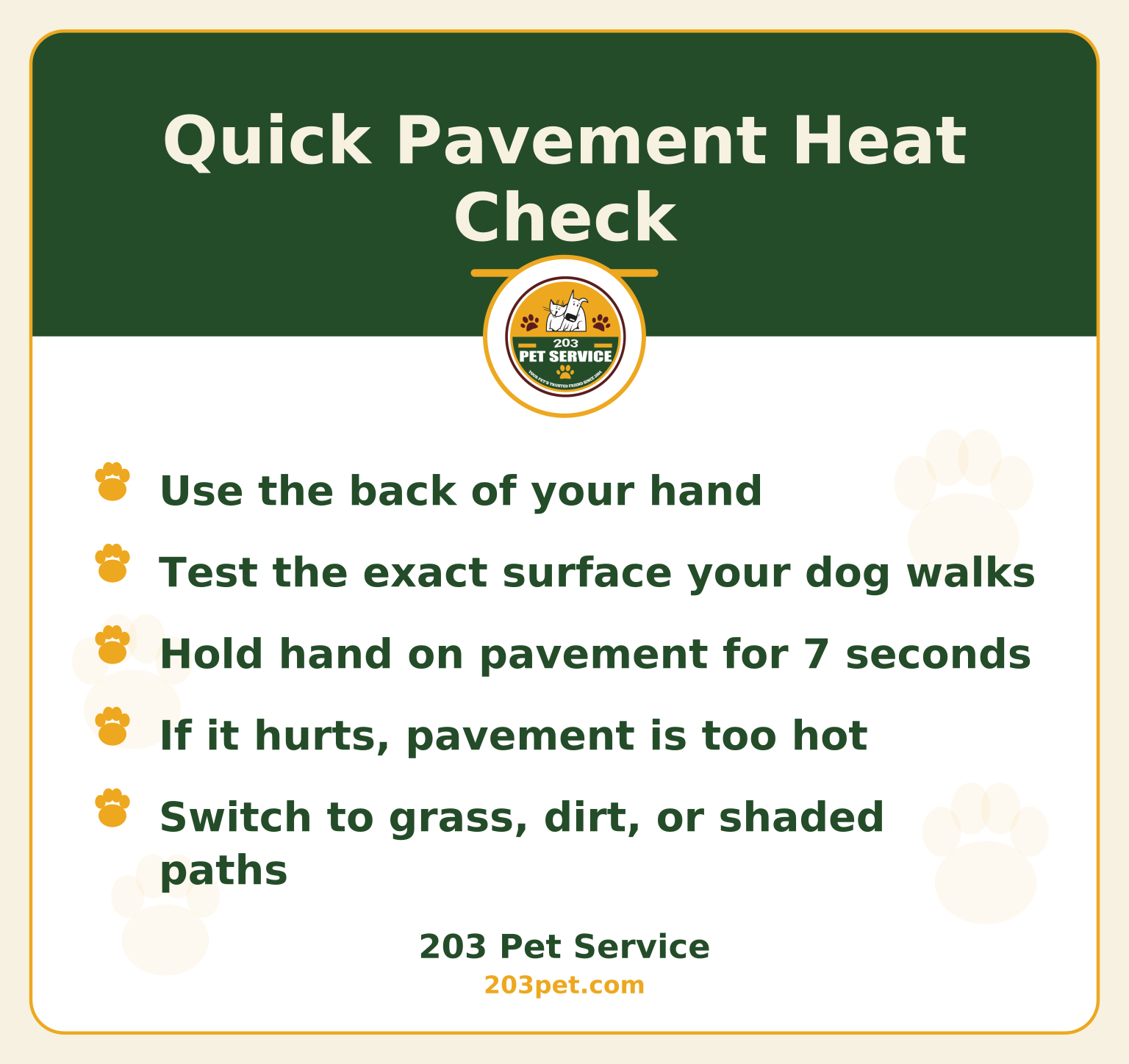
The fastest way to know if it is safe to walk your dog on a Fairfield County sidewalk or parking lot is the hand test. If you cannot hold your bare hand on the pavement for a full 7 to 10 seconds without pulling away, it is too hot for your dog's bare paws.
Pavement and blacktop soak up heat and can run 20 to 30 degrees hotter than the air. On an 85 degree day in Stratford or Bridgeport, that blacktop can be over 110 degrees. On a 90 plus degree afternoon, it can climb much higher. That is burn territory.
The hand-on-pavement test, step by step
Before you leave the driveway, crouch down and place the back of your hand firmly on the surface where your dog will walk:
- Pick the actual surface, not a shady patch if you plan to cross sunny areas.
- Use the back of your hand, which feels heat more like your dog's paw pads.
- Hold it there for at least 7 seconds. Count slowly.
- If it feels painful or you pull away early, do not walk your dog there.
According to PetMD's guide to dog walking, avoiding extreme temperatures on surfaces is one of the simplest ways to prevent paw injuries. That means you switch to grass, dirt, shaded sidewalks, or reschedule the walk.
Local hot spots that surprise people
In our years serving Fairfield, Stratford, Bridgeport, and nearby towns like Devon and Shelton, we see the same summer trouble spots over and over:
- Condo and apartment parking lots, especially big open ones without trees.
- School sidewalks and playground surfaces, like around Stratford High or local elementary schools.
- Large retail parking areas in Fairfield and Westport, where blacktop spreads out in all directions.
- Brick or stone walkways in Southport that hold heat longer into the evening.
It might look like a short walk from your car into a building. For your dog, standing on that surface for even a minute or two can be enough to burn pads.
What do burned paw pads look like and when should you call your vet?
Burned paw pads do not always show up right away during the walk. You might notice issues once you get home and the dog settles. Signs can include:
- Limping or refusing to walk, especially on certain surfaces
- Licking or chewing at their paws
- Paw pads that look darker, red, or swollen
- Blisters, peeling skin, or raw areas on the pads
The PetMD first aid guide notes that burns can be very painful and risk infection, so home care is limited. You can gently rinse with cool (not ice cold) water, keep your dog from licking, and call your veterinarian for next steps.
If your dog cries when you touch the paws, if you see raw tissue, or if your dog does not want to stand, you treat it as urgent. In very serious cases, we may suggest you contact an emergency hospital such as MedVet Norwalk Emergency Hospital or VCA Shoreline Animal Hospital in Shelton for advice after your primary vet closes.
Our salaried W-2 employees are trained to check paws as they walk and when they return a dog home. If they ever see a paw injury, they follow our emergency protocol, call Robyn in the office, and stay with your pet while we reach you.
What is the safest time and place to walk your dog in summer?
📺 Walk & Train Program - 203 Pet Service
The safest time to walk your dog in a Connecticut summer is early morning or later evening, when the sun is lower and pavement has cooled. The safest place is on grass or shaded paths, not on wide, exposed asphalt or concrete.
In July and August, we build most of our ongoing walking memberships in Fairfield, Stratford, and Bridgeport around cooler windows. If a dog normally gets a midday visit in spring, we often recommend shifting a chunk of that exercise to morning or early evening in summer.
Best times of day for Fairfield County summer walks
As a general rule:
- Early morning, roughly 6 a.m. to 9 a.m., is usually the best. Pavement has had all night to cool.
- Later evening, roughly 7 p.m. to 9 p.m., can also work, especially once the sun drops and shadows grow.
- Midday, roughly 11 a.m. to 4 p.m., is the riskiest period for heat plus pavement.
The exact times shift with each heat wave. On a 75 degree day, a midday grass walk in Easton might be fine. On a 95 degree day with humidity, even a 10 a.m. paved walk in Bridgeport can be too much for many dogs.
The AKC exercise guidance by breed reminds owners that most dogs still need daily activity, even when it is hot. So instead of skipping walks, you adjust when and how you walk.
Smarter routes: shade and grass over asphalt
Think about where you walk your dog now. Is it mostly on sidewalks and parking lots, or can you switch to softer, cooler surfaces?
In Fairfield County, we often choose:
- Tree-lined residential streets in Fairfield and Stratford, where shade covers much of the sidewalk.
- Grassy loops around apartment complexes in Bridgeport or Black Rock, instead of straight through the lot.
- Neighborhood green spaces in Westport and Southport, where we can stick to grass.
- Quiet rural roads and woods edges in Easton, early in the day when bugs and heat are lower.
We also plan routes so we can duck into shade often. Even a 30 second stop in the shadow of a big oak in Southport can lower heat load compared to walking straight down a sun baked block.
Skip the “errand buddy” habit in peak heat
I know it is tempting to bring your dog on quick errands. Coffee run in Fairfield. Post office in Bridgeport. Pickup at a school in Trumbull or Weston. In summer, that habit can turn risky fast.
Cars heat up shockingly quickly. According to PetMD hot weather safety advice, even with windows cracked, a parked car can climb to dangerous temperatures in minutes. So if your dog cannot come inside with you, they are better off at home in the air conditioning, with a walk scheduled before or after.
If your schedule is hectic in summer, this is where a reliable walking membership with trained W-2 dog walkers helps. Your dog still gets a safe, well planned walk, without sitting in a parking lot or waiting too long between breaks.
How much water, shade, and rest does your dog need on a hot walk?

On a typical 20 to 30 minute summer walk, most dogs need at least one good water break and one or more short shade breaks. Higher risk dogs often need more breaks, slower pace, and shorter distance.
Dogs dehydrate faster in heat. The ASPCA dog nutrition tips remind owners that access to fresh water is one of the most basic parts of good care, and that need climbs on hot days.
Practical water guidelines for a 20 to 30 minute walk
Every dog is different, but some general habits work well:
- Offer water before you leave, especially if you are walking in Fairfield, Stratford, or Bridgeport in the middle of summer.
- Carry a small bottle and collapsible bowl for each walk, even if you think you will be quick.
- Offer a drink at least once during the walk, more if the dog is panting heavily.
- Offer water again when you return, but let them drink in small amounts, not one huge gulp all at once.
For most medium sized dogs, sipping a few ounces at a time works fine. You do not need to measure it on the walk, you just avoid letting an overheated dog chug a full bowl in one shot, which can cause stomach upset.
Our walkers carry water on all longer visits. For short drop in walks, we always check that the dog has access to fresh water at home when we arrive and before we leave as part of our standard pet sitting and walking routines.
Simple shade and rest tricks in local neighborhoods
You do not need a park to find shade. In Fairfield County neighborhoods, we use a few easy tricks:
- Walk on the shadier side of the street. In many Fairfield and Stratford blocks, one sidewalk bakes while the other side stays in shadow.
- Pause beside hedges, garages, or tall fences that cast a long shadow.
- Use small green strips between sidewalk and street as quick cool down spots.
- In apartment complexes in Bridgeport or Black Rock, loop around the sides of buildings where the sun does not hit as hard.
We also build in short rest stops. That can be as simple as letting your dog stand and sniff a shaded patch of grass for 30 seconds. Sniffing is mental work and can help tire them out without extra heat strain.
The AKC first aid guidance stresses that cooling an overheated dog should be steady and moderate. Shade and rest do that gently, which is safer than sudden extremes like ice water.
What our walkers watch during hot weather visits
Because 203 Pet Service hires W-2 salaried employees, we train them and keep them long term. That means the person walking your dog in Westport, Easton, Wilton, or any of our core towns learns your dog's normal breathing, pace, and energy level.
On hot days our walkers always watch:
- Breathing rate and sound. Faster or noisier panting can be an early warning.
- Gum color. Gums should stay pink and moist, not pale, gray, or very dark red.
- Energy. A dog that usually pulls but suddenly lags, stumbles, or wants to lie down needs a break.
- Paws. We check for limping, lifting paws, or licking that hints at heat discomfort.
The VCA walking safety article points out that a responsible walker adapts plans based on what the dog shows on that day, not just on the clock. That is exactly how we approach every walk.
When does summer heat become an emergency for your dog?

Summer heat becomes an emergency when your dog goes past mild overheating into heat stroke. Signs like collapse, vomiting, seizures, or gums that turn pale, gray, or very dark red mean you stop everything and seek veterinary help right away.
Heat stroke can damage organs in minutes. The AKC first aid guide explains that dogs in heat stroke need prompt cooling and professional care, not just rest at home.
Clear signs of heat stress and heat stroke to watch for
You will often see a progression from mild heat stress to more serious trouble. Early heat stress can look like:
- Heavy panting that does not slow down with rest
- Bright red tongue or gums
- Weakness or wobbling
- Refusing to walk further
More severe heat stroke signs can include:
- Vomiting or diarrhea
- Collapse or being unable to stand
- Seizures or twitching
- Gums that turn very pale, gray, or dark brick red
- Glassy eyes, confusion, or unresponsiveness
According to the PetMD emergency care guide, you should treat these signs as an emergency, even if they seem to improve for a moment. Do not “wait and see” through the afternoon in Fairfield or Stratford while you hope your dog bounces back.
What to do right away if your dog overheats
If you think your dog is moving into serious heat stress or heat stroke while you are out walking in Bridgeport, Westport, or any nearby town, you act quickly by stopping the walk, moving to shade, offering small amounts of cool water, and calling your veterinarian or the nearest emergency hospital right away.
Frequently Asked Questions

About This Topic
What time of day is actually safest to walk my dog in summer?
In Eastern Fairfield County, it’s safest to walk your dog before 9 a.m. or after 7 p.m., when pavement and air temps have dropped. Aim for shady routes on grass or dirt instead of blacktop. Always do the 7‑second hand test on pavement. If it’s too hot for your hand, it’s too hot for paws.
How can I tell if the pavement is too hot for my dog?
Use the 7‑second test: place the back of your hand on the pavement and hold it there for a full 7 seconds. If you have to move your hand because it’s uncomfortable, your dog shouldn’t walk on it. Stick to grass, dirt, or shaded sidewalks. 203 Pet Service walkers use this test on every hot‑weather visit.
What are early signs my dog is getting overheated on a walk?
Watch for fast or heavy panting, bright red gums or tongue, suddenly slowing down, or trying to lie down in the shade. Some dogs also get glassy eyes or seem unsteady. If you see any of this, stop the walk, move to shade, offer cool (not ice‑cold) water, and head home. Call your vet if they don’t improve quickly.
How hot is too hot to walk my dog in Fairfield County?
Once air temps are over about 80°F with humidity, many dogs start to struggle, especially in full sun. In the upper 80s and 90s with that sticky shoreline humidity, even short pavement walks can be risky. Shorten walks, stick to shade and grass, and avoid mid‑day. Brachycephalic breeds and seniors usually need even more caution.
What should I do right away if my dog overheats on a walk?
Get your dog into shade or air conditioning immediately and stop all activity. Offer small amounts of cool water and start cooling their body with cool, damp towels on the paws, belly, and armpits, and avoid ice baths. If they’re vomiting, collapsing, or seem very out of it, go to an emergency vet. Then shorten future walks and adjust your schedule.
Are there safer walking routes or surfaces around towns like Fairfield and Stratford?
Yes, look for tree‑lined streets, parks, and grassy paths instead of big parking lots or open sidewalks with no shade. Avoid dark blacktop, school lots, and brick walkways that bake in the sun. In towns like Fairfield, Stratford, and Bridgeport, plan loops that let you bail out quickly if your dog gets hot. 203 Pet Service walkers build these cooler routes into their daily schedules.
Can a short bathroom break on hot pavement really burn my dog’s paws?
It can, especially on dark blacktop that’s been in direct sun. Pavement can be 30, 40 degrees hotter than the air, so a quick potty walk at 2 p.m. in July can still cause painful burns. Try using grassy areas close to home and carry your dog over very hot spots if they’re small. Always test the surface first with your hand.
If I’m at work, how does 203 Pet Service keep summer walks safe?
203 Pet Service schedules walks for cooler parts of the day whenever possible and adjusts routes based on the day’s heat and humidity. Their W‑2 employees use the 7‑second pavement test, stick to shade and grass, and cut walks short if a dog shows heat stress signs. They’ll also refresh water, close blinds, and follow any vet‑recommended heat precautions you share.
About 203 Pet Service
What areas does 203 Pet Service cover in Fairfield County?
We provide professional dog walking, pet sitting, and training services across Eastern Fairfield County, Connecticut. We proudly serve families in Fairfield, Stratford, Westport, Easton, Southport, Black Rock, Bridgeport, Shelton, Devon, Trumbull, Weston, and Wilton. 203 Pet Service has cared for pets in Fairfield County since 2004, and every visit is handled by a trained, W-2 salaried employee who is background checked and fully insured.
Why does 203 Pet Service use salaried W-2 employees instead of independent contractors?
We believe salaried W-2 employees provide more reliable, accountable, and professional pet care. Unlike independent contractors, our salaried employees go through careful background checks, full training, and are fully insured. This employment structure means consistency, accountability, and peace of mind for Fairfield County pet families.
How do I schedule a meet and greet with 203 Pet Service?
Just call us at (203) 682-6443 or fill out our contact form. We will schedule a meet and greet where you can meet your potential sitter or walker, talk through your pet's needs, and see firsthand why Fairfield County families have trusted us since 2004. There is no obligation, just a chance to see our professional approach to pet care.