
Your First Month With an Adopted Dog in Eastern Fairfield County
Quick Answer: Your first month with an adopted dog in Eastern Fairfield County should focus on calm, predictable routines, lots of quiet time to decompress, and simple training that builds trust. Set up a safe space, stick to regular feeding and potty schedules, keep walks low key around local streets and parks, and get help from local vets, trainers, and pet pros if you feel stuck.
Your First Month With an Adopted Dog in Eastern Fairfield County
Bringing home an adopted dog in Eastern Fairfield County feels amazing and a little chaotic at the same time. The first month with a new rescue dog is usually messy, emotional, and full of small wins. That is all normal, and with a simple plan, you and your dog can settle in without burning out.
In our 22 years walking dogs and caring for pets in Fairfield, Stratford, Westport, Easton, Southport, Black Rock, and Bridgeport, we have seen the same patterns over and over. The dogs who do best have calm homes, clear routines, and humans who give them time to decompress.
This guide walks you through your first month, week by week, with practical, local tips that fit real life in Eastern Fairfield County.
How should you prepare your Eastern Fairfield County home before your dog’s gotcha day?
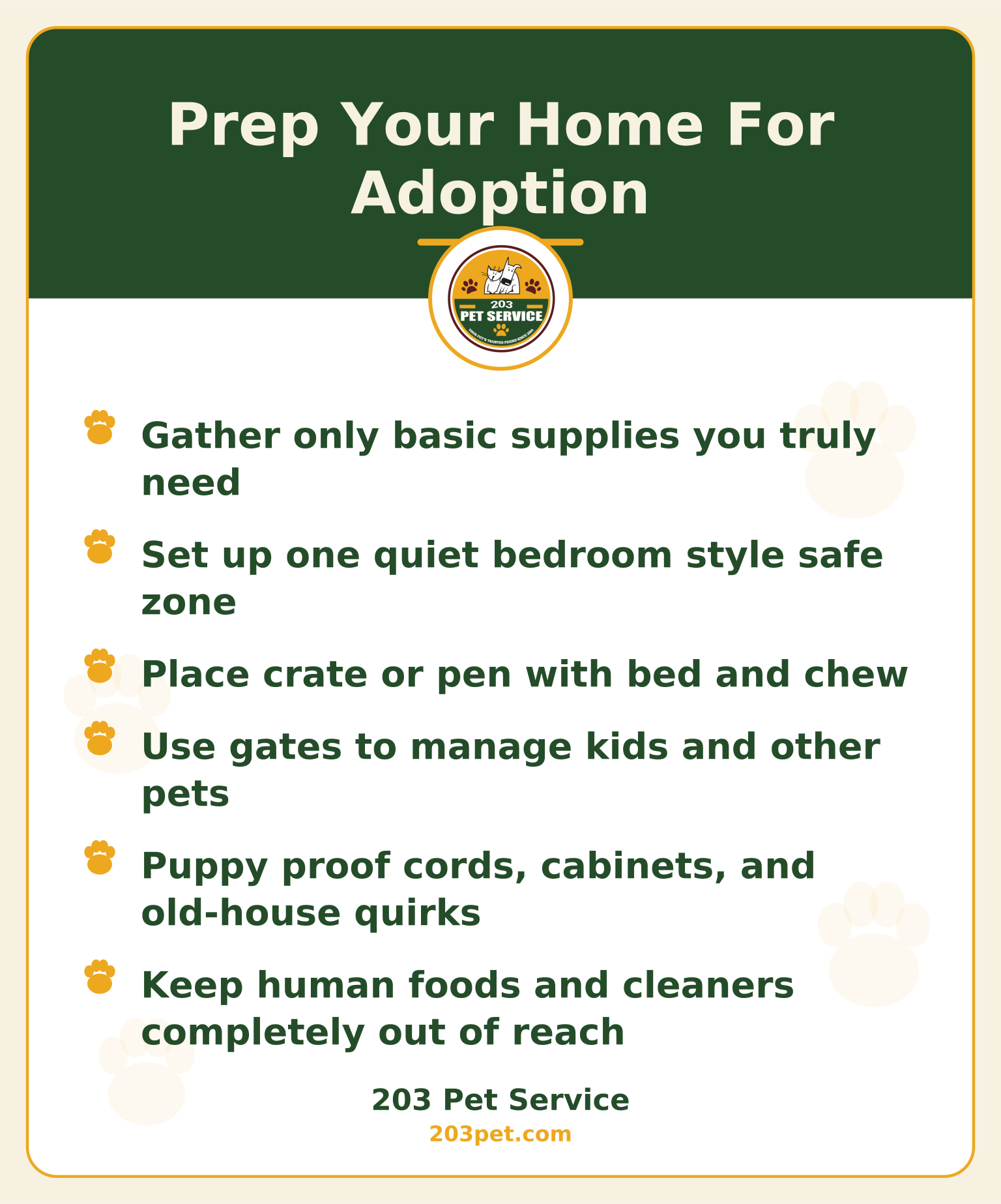
You only need a few core supplies, a safe place to rest, and some basic puppy-proofing before gotcha day. You do not need to buy out the pet store to welcome an adopted dog home.
Simple supply list that actually gets used
Start with the basics. You can always add more once you know your dog better.
- Flat buckle collar with ID tag and your phone number
- 4 to 6 foot leash (no retractable at first)
- Crate or playpen sized for your dog
- Two stainless steel bowls for food and water
- High quality food (ideally what the shelter or rescue used for now)
- Poop bags and a simple holder for walks
- Few chew toys and puzzle toys, not a full basket
- Soft bed or folded blankets
- Enzyme cleaner for potty accidents
If you are bringing home a puppy, a lot of the puppy prep looks the same as what you see in new puppy checklists. The American Kennel Club’s puppy preparation guide also works very well for many young rescue dogs.
Creating safe spaces in apartments, condos, and houses
Whether you live in a Black Rock apartment, a condo near downtown Bridgeport, or a single family home in Fairfield or Easton, your dog needs one main quiet zone. Think of it as their bedroom.
Pick an area that is:
- Away from the front door and heavy foot traffic
- Not in direct line of big windows facing busy streets
- Cool in summer and not right on a draft in winter
Place the crate or pen there with a bed and a chew. For some dogs, especially nervous rescues, covering part of the crate can help them feel more secure. The Merck Veterinary Manual notes that dogs are natural den animals, so a cozy, cave-like spot often lowers stress.
Gates, crates, and kid zones
If you have kids or other pets, physical barriers keep everyone safe while your dog adjusts. Use baby gates to block off stairs, kitchens, and hallways. Make one rule clear to children on day one. When the dog is in the crate or on their bed, they are off limits.
In many Stratford and Westport homes, we see a simple setup that works very well. Crate against a wall, gate at the kitchen entry, and a blanket that marks the “don’t bother me” spot. Simple, clear, easy for kids to understand.
Local puppy proofing tips for older Fairfield County homes
Older homes in Fairfield, Bridgeport, Easton, and Southport often have quirks. Exposed radiator pipes, loose floorboards, random gaps behind washers and dryers. Do a slow walk-through from dog height.
- Check baseboards and door frames for peeling paint or splinters
- Secure loose electrical cords with cord covers or zip ties
- Use baby locks on under-sink cabinets that hold cleaners
- Block off damp basements if there is any mold or standing water
Also look at food on counters and tables. Many common human foods can harm dogs, including grapes, chocolate, onions, and xylitol sweeteners. The AKC list of safe and unsafe human foods for dogs is a good quick reference.
If your new dog gets into something and you are not sure if it is toxic, call your vet or an emergency hospital. Guides from PetMD on what to do if a dog eats something they should not can also help you decide what to do next.
What should you do on gotcha day and the first 24 hours?

Keep day one as quiet and simple as you possibly can. Your new dog has already had a big day with a car ride, new smells, and new faces.
Bringing your dog home calmly
When you pick up your dog in Fairfield, Bridgeport, or anywhere else, clip the leash before you open the car door. Even a calm dog at the shelter can bolt when they see open space. Walk them to the car on leash, then secure them with a harness and seat belt clip, or in a crate.
When you arrive home, take them for a slow potty walk before you go inside. Let them sniff the immediate area. Stay relaxed and avoid crowding their face or hugging them. The UC Davis veterinary behavior resources stress that giving dogs space and choice early on helps lower fear.
Why less company is better on day one
Many families in Westport and Southport want to invite grandparents, neighbors, and every dog friend over to meet the new arrival. Try not to. Extra people mean extra noise and pressure.
Limit day one to the people who actually live in your home. Introduce them one at a time, sitting sideways, letting the dog come to them. No squealing, no grabbing, no forced photos. You will have plenty of time for that later.
First walk around your block
That first walk around your block in Black Rock, Stratford, or Easton should be short and uneventful. Think sniff, potty, home. Do not aim for a full exercise walk yet.
If your dog freezes or pancakes on the sidewalk, that is fear. Do not drag them. Turn back and try the driveway or yard only. As they settle, you can slowly add more distance. Different dogs need different exercise levels. The AKC exercise guide by breed has helpful ranges, though with a mixed breed rescue, you will mostly watch the dog in front of you.
Simple food, water, and sleep plan on day one
Offer water as soon as you get home, but do not let a thirsty dog gulp a full bowl at once. Give a bit, wait a few minutes, then a bit more. For food, start with a small meal of what they ate at the shelter or rescue.
For the first night, many dogs do better with the crate in your bedroom or close by. They hear you breathing, which helps them relax. If they whine, give a calm “you are ok” once or twice, then wait. If you rush to the crate every time, you can accidentally teach them that whining always brings you over.
Our ongoing dog walking service often starts within the first week for adopted dogs whose families work long hours. A stable walker showing up on a regular schedule can make this first stretch much easier.
What should week one with your adopted dog look like?

In week one, focus on building trust, not teaching a ton of new skills. Your dog is still figuring out if your home is safe.
The 3-3-3 rule in plain language
Many rescue groups talk about the 3-3-3 rule. It is a simple way to think about adjustment:
- 3 days to decompress
- 3 weeks to start to settle into a routine
- 3 months to feel fully at home
During those first 3 days in Fairfield, Stratford, Bridgeport, or anywhere in Eastern Fairfield County, your dog might be extra tired, extra clingy, or extra shut down. None of that means you are doing it wrong. It just means their brain is still catching up.
Early stress signs to watch for
Stress in dogs does not always look like growling or biting. It often shows up as:
- Hiding under furniture or behind you
- Pacing the same path over and over
- Panting when it is not hot
- Yawning, lip licking, or turning their head away
- Excessive shedding in short bursts
If you see these, give them more space, keep visitors to a minimum, and shorten outings. Basic first aid skills help too, since some stressed dogs get small cuts or torn nails as they explore. The AKC guide to first aid for dogs and PetMD’s dog first aid overview are good references for minor injuries and when to call the vet.
Setting a gentle daily schedule
By day two or three, start a loose routine. In many Fairfield and Bridgeport homes, a simple pattern like this works:
- Morning potty walk
- Breakfast, then quiet crate or pen time
- Midday walk or play break
- Afternoon nap time
- Early evening walk and dinner
- Short bedtime potty walk
Dogs relax when they know what comes next. If your work schedule makes this hard, our W-2 salaried employees can provide steady weekday dog walking so your dog is not left guessing when they get out.
Potty accidents and leash pulling without drama
Accidents in the house are not your dog trying to upset you. They usually mean you went too long between breaks or the dog is still confused about where to go.
Clean accidents with an enzyme cleaner. Do not rub their nose in it or yell. Take them out more often and praise calmly when they pee or poop outside.
For leash pulling, think “tree” not “tug of war”. When your dog hits the end of the leash and pulls, stop. Stand still until they look back or pressure on the leash loosens. Then walk again. Over time, they learn that pulling makes the walk stop.
If you feel stuck, this is a good stage to loop in a professional. Jason is an ABC Certified Dog Trainer and has helped many rescue dogs in Fairfield County learn loose leash walking in a kind, structured way.
Video: A practical AKC tutorial on how to crate train your dog using short, positive sessions.
How do you build a routine in week two in Eastern Fairfield County?

Week two is when your adopted dog usually starts to test boundaries a little. This is a good thing. It means they feel safer. Now you can slowly stretch walks, introduce a few people, and start simple training.
Longer walks on familiar local routes
Stick with the same general walking routes at first. In Fairfield and Stratford, that might mean looping your block near the school instead of exploring the whole neighborhood right away. In Westport or Southport, maybe it is the same two or three quiet side streets.
Once your dog walks that route comfortably, you can add an extra block or two. For high energy dogs, consider a regular walking membership with our dog walking service. Steady, weekday walks with the same W-2 employee help dogs burn energy in a safe, predictable way.
Introducing family, friends, and dog neighbors
In week two, you can start letting a few trusted people meet your dog. Keep things quiet. Ask visitors in Bridgeport, Easton, or Black Rock to ignore the dog at first. Let the dog decide if they want to sniff or say hello.
Dog introductions should happen on neutral ground, on leash, with both dogs given plenty of space. Parallel walking, where both dogs walk the same direction several feet apart without greeting, often works better than nose to nose meetings.
Easy brain games with what you already own
You do not need fancy puzzle toys to work your dog’s brain. Try:
- Scatter feeding: toss part of their kibble in the grass and let them sniff it out
- Towel burrito: roll treats into a towel and let them nose and paw it open
- Muffin tin game: put kibble in muffin cups, cover some with tennis balls
Mental work tires dogs in a different way than physical exercise. This matters especially for older dogs or those with joint concerns, since heavy impact exercise can bother arthritis. The AKC guide to dog arthritis explains why gentle, controlled activity usually helps these dogs more than long, hard runs.
When and how to start basic training
By the second week, many dogs are ready for short training sessions. Keep it light and positive. Think 3 to 5 minutes, a few times a day, with lots of treats and praise.
Good first cues include:
- Name recognition
- Coming when called in the house
- Sit and wait before meals
- Going to bed or mat on cue
If you want formal help, look for classes that use reward based methods and small class sizes. As an ABC Certified Dog Trainer with 29 years of experience, Jason always recommends trainers who understand rescue dogs and behavior, not just obedience. If you would like to talk through options in Fairfield County, reach out through our contact page.
How can you safely add outings and alone time in weeks three and four?

By weeks three and four, most adopted dogs in Fairfield, Stratford, Westport, Easton, Southport, Black Rock, and Bridgeport start to feel like part of the family. This is when you can carefully add new places and work on alone time so they do not panic when you leave.
Short car rides and new places without overwhelm
Start with very short car rides. Drive around the block or to a quiet parking lot, feed a few treats, then go home. Once your dog rides calmly, try slightly longer drives, maybe to a calm trail or a friend’s fenced yard.
Avoid busy festivals, crowded beaches, or dog parks in this stage. Many rescue dogs find off leash dog parks very stressful, especially in the first few months. Controlled walks on leash are enough for now.
Teaching your dog that alone time is safe
Alone time training starts in small bits while you are still home. Put your dog in their crate or gated area with a safe chew, then walk out of the room for a minute. Come back before they panic.
Over days, slowly stretch that time. Put on shoes, pick up keys, step outside for a minute, then come back. You want your dog to learn that you leave and you also return, over and over.
If you work long hours in Fairfield County, consistent midday support helps a lot. Our in-home pet sitting visits and recurring dog walking memberships give your dog regular breaks so they are not alone for 9 or 10 hours straight.
Early signs of separation anxiety
Some barking and whining when you first leave is normal while a dog learns the routine. Red flags for true separation anxiety include:
- Panicked barking or howling that lasts a long time
- Chewing or clawing doors, crates, or window frames
- Drooling pools of saliva when left alone
- Breaking out of crates to reach doors or windows
If you see these signs, talk with your vet and a qualified trainer quickly. Behavior problems are easier to help when you catch them early. UC Davis and other veterinary schools note in their animal health behavior articles that early intervention often leads to better outcomes.
When to reach out for extra help
If your dog’s behavior gets worse, not better, across this first month, you do not need to handle it alone. Sudden changes in behavior sometimes have medical causes, like pain, ear infections, or tummy trouble, not just training gaps.
Frequently Asked Questions

About This Topic
What should I do on the actual day I bring my rescue home?
Keep gotcha day calm and boring. Take your dog straight home, do a quick potty break in the yard, then let them explore one or two rooms, not the whole house. Give water, a simple meal, and lots of rest. Skip visitors and busy errands, and if you’re in Eastern Fairfield County, 203 Pet Service can handle walks or drop-ins so you can focus on settling in.
How much should I walk my newly adopted dog in the first month?
For the first week or two, think short, quiet walks around your block, not big adventures. Two to four 10 to 15 minute walks a day is plenty while your dog decompresses and learns your routine. Avoid crowded parks at first. If your schedule’s tight, 203 Pet Service can do low-key, structured walks in your Fairfield County neighborhood.
My new dog is hiding and seems shut down, should I be worried?
Hiding, sleeping a lot, and acting a bit shut down are really common in the first week or two. Give your dog a safe, quiet spot with a bed or crate, keep routines predictable, and don’t force affection. Talk softly, toss treats instead of reaching in. If you’re unsure whether it’s normal, 203 Pet Service can observe during visits and share what they’re seeing.
How do I create a simple daily routine for my adopted dog?
Pick set times for morning potty, breakfast, midday break, dinner, and last potty, and stick to them every day for at least the first month. Keep walks, meals, and rest blocks in the same order so your dog can predict what’s next. In Eastern Fairfield County, 203 Pet Service can cover midday walks so your weekday schedule stays consistent.
When should I introduce my adopted dog to local dog parks or beaches?
Wait at least a few weeks before trying busy dog parks or beaches like those in Fairfield or Stratford. Start with quiet neighborhood walks and let your dog watch the world from a distance. When they’re more relaxed and responsive to you, try short visits during off-peak hours. If you’re unsure, 203 Pet Service can suggest dog-friendly spots that match your dog’s energy and comfort level.
What’s the best way to handle potty training with an adopted adult dog?
Treat them like an untrained puppy at first: frequent trips outside, especially after waking, eating, and playing, and lots of praise for going in the right spot. Supervise indoors or use a crate or playpen to prevent silent accidents. Clean mistakes with an enzyme cleaner so they don’t re-mark. If you work long hours, 203 Pet Service can provide consistent midday breaks to speed up progress.
My new dog barks or cries when I leave, what should I do early on?
For the first month, keep departures low-key and practice very short absences, like stepping outside for a minute and returning before your dog panics. Give a safe chew or food puzzle as you go, and avoid big goodbye rituals. If you need to be out for longer stretches, 203 Pet Service can break up the time with drop-in visits or walks so your dog isn’t alone too long.
How can 203 Pet Service actually help during my dog’s first month home?
203 Pet Service can handle calm, structured walks, potty breaks, and drop-in visits so your new dog gets consistent care while you juggle work and life. We’re familiar with local vets, trainers, and behaviorists in Fairfield County and can point you to the right support if issues pop up. Our goal is to keep routines steady and low-stress while your dog settles into their new home.
About 203 Pet Service
What areas does 203 Pet Service cover in Fairfield County?
We provide professional dog walking, pet sitting, and training services across Eastern Fairfield County, Connecticut. We proudly serve families in Fairfield, Stratford, Westport, Easton, Southport, Black Rock, Bridgeport, Shelton, Devon, Trumbull, Weston, and Wilton. 203 Pet Service has cared for pets in Fairfield County since 2004, and every visit is handled by a trained, W-2 salaried employee who is background checked and fully insured.
Why does 203 Pet Service use salaried W-2 employees instead of independent contractors?
We believe salaried W-2 employees provide more reliable, accountable, and professional pet care. Unlike independent contractors, our salaried employees go through careful background checks, full training, and are fully insured. This employment structure means consistency, accountability, and peace of mind for Fairfield County pet families.
What services does 203 Pet Service offer?
We provide daily dog walking, pet sitting (overnight and vacation), cat care, backyard play sessions, litter box scooping, and puppy training classes. All services are done by our salaried W-2 employees who bring professional training and genuine care to every visit. Whether you need regular midday walks or full vacation care, we cover all 12 Fairfield County service towns.