
Your Puppy’s First Week Home: Simple Routines That Work
Quick Answer
Set up one small safe zone for your puppy on day one, keep food, potty breaks, sleep, and play on a simple repeating schedule, and use the same calm words and routines every time. Focus on a few habits you can actually keep doing with your Fairfield County work and kid schedule, and your puppy will start to relax, learn faster, and fit into your busy home.
Your Puppy’s First Week Home: Simple Routines That Work
If you just brought home a puppy in Eastern Fairfield County, you are probably excited and a little exhausted already. Your puppy’s first week home does not have to be perfect. A simple routine you can actually stick with will help your puppy relax and help your family breathe a bit too.
In our 22 years walking dogs and caring for pets in Fairfield, Stratford, Westport, Easton, Southport, Black Rock, and Bridgeport, we have seen the same thing over and over. The families who do best in that first week are not the ones who do everything. They are the ones who pick a few simple habits and repeat them.
Let’s walk through what that can look like for you, even if you are juggling Metro-North, I-95, the Merritt, and kids’ sports in three different directions.
Why should you start with one safe puppy zone on day 1?
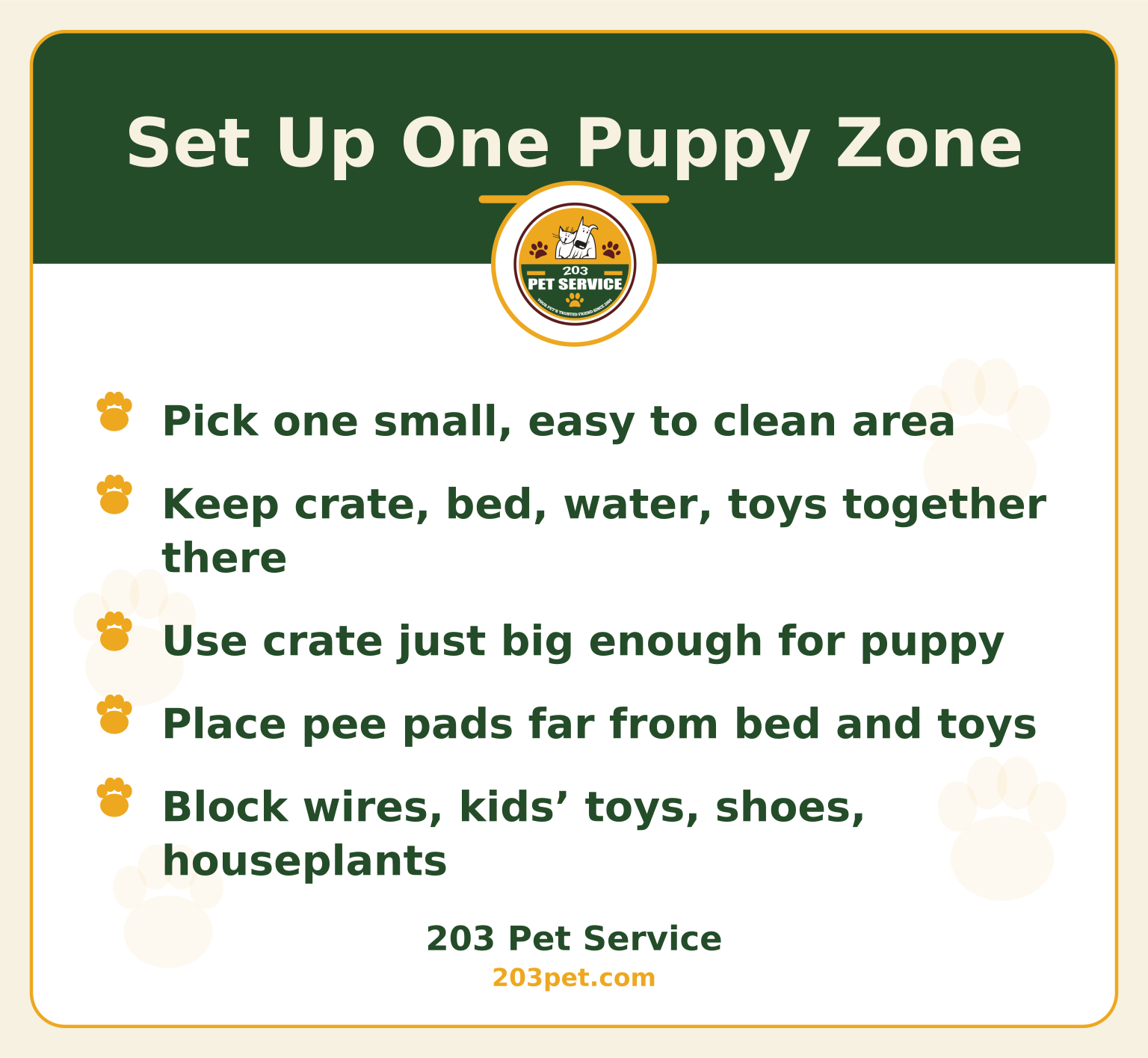
You should start with one safe puppy zone on day 1 because it keeps your puppy contained, protects your house, and makes training much easier. One main area also lets your kids know where the puppy “lives” so the rules stay clear.
When a puppy first walks into a home in Fairfield County, they do not know where anything is. They do not know what is safe to chew, where to sleep, or where to go to the bathroom. If you give a young puppy full access to your whole Westport colonial or your Bridgeport apartment, you turn that first day into a game of “catch the puppy before they eat the phone charger.” According to the American Kennel Club new puppy prep guide, setting up a defined safe space is one of the first things new puppy owners should do.
Think of this as your puppy’s studio apartment. Everything they need is in that one spot. Life is simple there. You can always give them more freedom later when they are trained.
What belongs in your puppy zone?
Pick one easy-to-clean area where your family spends time. A corner of the living room in a Stratford ranch. A gated section of the kitchen in a Fairfield beach house. A quiet spot in a Bridgeport first-floor condo.
In that zone, you want:
- A crate or exercise pen that is just big enough for your puppy to stand up, turn around, and lie down. If it is too big, puppies may sleep in one corner and pee in the other.
- A bed or mat that is comfy but washable. Some puppies chew soft beds at first, so you may start with a simple blanket.
- Water bowl that is heavy enough not to tip. For very small puppies, a shallow bowl works best.
- Safe chew toys like rubber toys and frozen Kongs. Skip stuffed toys with tiny parts that can be swallowed. The Merck Veterinary Manual reminds owners that puppies explore the world with their mouths, so safe objects matter.
- Potty plan. If your puppy will go to the bathroom outside, the potty area is the yard, not the indoor zone. If you live in a third-floor walkup in Black Rock or Bridgeport and you are using pee pads at first, place them away from the bed and toys.
Keep anything chewy but unsafe out of reach. That means wires, kids’ toys, shoes, and houseplants. The PetMD guide on dogs eating unsafe things lists common household items that can send a puppy to the vet very fast. It is easier to block them off now than deal with an emergency later.
How do you handle the first few hours with kids and visitors?
Those first hours home set the tone. Think calm and simple. Not a surprise party.
If you have kids, coach them before the puppy walks in:
- Let the puppy walk into the house by themselves, do not grab.
- Sit on the floor, let the puppy come to them.
- Use quiet voices and gentle hands.
Friends and neighbors will want to visit, especially in close-knit streets in Easton or Southport. You can absolutely let people say hello, but keep visits short. Two or three people at a time is plenty. Many puppies feel tired and overstimulated after the car ride. Piling on a crowd makes that worse.
Have a quick house rule: if the puppy goes back into their crate or walks away, that means break time. Respect that. Growing puppies need an enormous amount of sleep. The AKC puppy training timeline points out that rest is just as important as play for healthy development.
What does a realistic first-week puppy schedule look like for busy Fairfield County parents?

A realistic first-week puppy schedule has short, frequent potty breaks, plenty of naps, tiny training moments, and planned help during your longest work stretches. You do not need a perfect minute-by-minute chart, but you do need a loose rhythm for mornings, mid-days, evenings, and nights.
Most of our clients in Fairfield and Westport are juggling I-95 traffic, Merritt backups, and Metro-North delays. So the schedule below assumes a full-time job plus a commute. You can slide the times earlier or later to match your life.
How long can a young puppy hold it?
A common rule of thumb is age in months plus one for daytime hours. So a 9-week-old puppy (about 2 months) may hold it for 3 hours during the day. That is a guideline, not a promise. At night, many puppies can stretch a bit longer because they are sleeping.
In real life, that looks like:
- 8 to 10 weeks: every 2 to 3 hours when awake
- 10 to 12 weeks: every 3 hours when awake
- 3 to 4 months: every 3 to 4 hours when awake
Very small breeds often need more frequent trips. Big-breed puppies sometimes handle a bit longer. Either way, their bladder is not ready for a full workday alone. The AKC vaccination schedule also reminds owners that young puppies’ immune systems are still developing, so stress and holding it too long do not help.
Sample weekday schedule for working parents
Here is a simple weekday example for a family that leaves Stratford or Bridgeport around 8:00 a.m. and gets home around 5:30 p.m.
- 6:00 a.m. Wake, straight outside to potty, praise and treat.
- 6:15 a.m. Breakfast in the crate or puppy zone.
- 6:45 a.m. Out to potty again, then a short play session.
- 7:15 a.m. Back in the crate or pen with a safe chew while you get ready.
- 7:45 a.m. Quick potty trip before you leave.
- Late morning: Midday potty break and brief play. This is where a trusted local dog walking membership helps.
- Early afternoon Second potty break if your puppy is very young or tiny.
- 5:30 p.m. Home, straight out to potty, then calm hello.
- 6:00 p.m. Dinner.
- Evening Short play periods, simple training, and rest in the puppy zone.
- Bedtime Last potty trip, then into the crate for the night.
Notice what is missing. Long walks. Big outings. Hours of training. In week one, your puppy needs structure more than they need distance. Exercise matters, but the AKC exercise guideline points out that young puppies do best with short, frequent activity instead of long, hard sessions.
When should you plug in a local dog walker?
If your puppy will be alone more than 3 hours while you are at work, you should plan midday help. That might mean a neighbor while you are still on leave. Very often it means a professional walker once you are back at the office in Fairfield or commuting to Stamford or New York.
This is where our salaried W-2 employees come in. At 203 Pet Service we offer ongoing dog walking memberships, not one-off random visits. That matters with puppies, because the same walkers come consistently. They learn your puppy’s quirks, track potty habits, and follow your house rules.
In practical terms, many of our Bridgeport and Black Rock puppy clients start with 2 short visits on long workdays. One late morning, one mid-afternoon. As the puppy grows and can hold it longer, we taper that to a single midday walk that continues into adulthood.
How do you potty train your puppy without constant stress?

You potty train your puppy without constant stress by sticking to a simple schedule, using the same words every time, rewarding them outside, and cleaning mistakes inside quietly and well. No yelling, no rubbing noses, no drama.
Puppies are not being stubborn when they have accidents. They just do not know the rules yet. Your job in week one is to make those rules very clear and very consistent.
Your first-week potty schedule
In that first week, take your puppy out:
- Right when they wake up, every time
- After every meal
- After play sessions
- Before they go in the crate
- As soon as they come out of the crate
- Any time they start sniffing, circling, or wandering off
Pick one outdoor potty spot in your yard or near your building in Westport or Easton. Walk your puppy to that same place on a leash. Stand still, give them a minute, and use a simple phrase like “Go potty.” The whole family should use the same words.
When they finish, calmly praise and give a tiny treat right there in the yard. Not when you come back inside. Puppies learn best in the moment. The AKC puppy training timeline stresses immediate, consistent rewards so good habits stick.
What do you do after accidents?
Accidents will happen. On your rug. Right after you walked in from outside. Usually when you are distracted for 30 seconds. That is normal.
Here is what to do:
- Stay calm. If you catch your puppy mid-pee, say “Outside” once and gently move them to the yard or pad.
- Do not punish. No yelling, no shoving their nose in it. That only teaches puppies to hide and go in secret.
- Clean with an enzymatic cleaner made for pet urine. Regular cleaners leave smells that your puppy still picks up. Smell tells them “bathroom goes here.”
The same rule holds for chewing something they should not. Avoid panic. Move them, swap in a safe toy, and keep going. When something might be dangerous, like your puppy chewing a battery or a pill bottle, call your vet or an emergency hospital right away. The PetMD first-aid guide and the AKC first-aid tips both say the same thing. When in doubt, get professional help fast.
Simple potty rules everyone can remember
Make a small list and stick it on the fridge:
- Same door out every time.
- Same potty spot.
- Same cue words.
- Reward outside, not inside.
- No unsupervised freedom yet.
If you are consistent, many puppies in Fairfield County start to get the idea within a few weeks. Full reliability takes longer, so give yourself some grace.
How can you safely socialize your puppy around town in the first week?

You can safely socialize your puppy in the first week by pairing gentle new sights and sounds with treats, keeping outings short, and avoiding high-dog-traffic areas until vaccines are complete. Socialization does not mean dog parks yet. It means steady, positive exposure.
According to the AKC vaccination guide, most puppies are not fully protected against diseases like parvo until they finish their vaccine series. That usually happens between 16 and 18 weeks. So in the first weeks, you want to balance health safety with social learning.
Gentle neighborhood exposure
In your first week in Fairfield, Stratford, or Westport, think small. You can:
- Carry your puppy for a quick walk down your street so they see cars and hear traffic.
- Stand at a safe distance from the Post Road, train station, or a local playground, and feed treats while your puppy watches.
- Let your puppy explore your front yard on leash while they listen to leaves, birds, and distant trucks.
If you live near a quieter park or walking path, like trails in Easton or a calm corner of a waterfront area in Southport, that is perfect. Stay on the path, do not let your puppy sniff other dogs’ waste, and skip shared water bowls. You control the distance. If your puppy freezes, backs up, or tucks their tail, you are too close. Step back, make it easier, and feed a few treats.
Meeting people and kids without overwhelm
Humans are a big part of socialization too. You want your puppy to see all sorts of people in that first week, but not all at once and not on top of them.
Try this:
- Invite one calm adult at a time over to your home in Black Rock or Bridgeport.
- Ask them to sit, let the puppy approach, and give a treat only if the puppy chooses to interact.
- If you have kids, have them walk by, drop treats on the floor, then walk away.
- Play recordings of street noise or fireworks softly while giving your puppy a chew, then slowly raise the volume over days.
The key word is “opt-in.” Let your puppy decide to visit. Do not let kids chase, hug tightly, or pick up a struggling puppy. Calm, predictable handling now builds a dog who trusts people later.
What about meeting other dogs?
In week one, you can introduce your puppy to a few healthy, friendly, fully vaccinated adult dogs you trust. Think of a chill older golden in Fairfield or a relaxed beagle in Stratford that belongs to a friend. Skip dog parks and random sidewalk greetings for now.
Plan one-on-one play in a clean yard or home. Keep leashes loose, watch closely, and give breaks often. If either dog seems stressed, separate for a bit. The Merck Veterinary Manual notes that body language tells you a lot about how dogs feel. Look for loose bodies, wagging tails, and easy movement, not stiffness.
How do you handle crate time, bedtime, and alone time from day one?

You handle crate time, bedtime, and alone time from day one by making the crate a happy place, keeping nights simple and close, and adding very short “alone” practice sessions during the day. Done well, this sets you up for a dog who can relax when you leave for work in Fairfield County.
Making the crate feel safe
Think of the crate like a den, not a jail. You want your puppy to choose to go in there. Feed meals in the crate, toss treats in during the day, and drop a stuffed Kong inside when you need to step away.
Good crate tips:
- Start with the crate in a quiet corner of the main living space.
- Use a light blanket or cover on part of the crate to make it feel cozy, but not too hot.
- Never use the crate as punishment.
If your puppy chews bedding, you may use a crate mat or no soft bedding when you are not watching until they grow out of that phase. Safe beats fancy.
Where should the crate go at night?
In the first week, put the crate in your bedroom or right outside with the door open and a baby gate. Your puppy just left their mom and litter. Being completely alone in a back room of a Westport house overnight is scary.
At night:
- Take your puppy out last thing, then calmly put them in the crate.
- If they fuss, give them a minute to settle. Many fall asleep once they realize nothing bad is happening.
- If they wake and cry later, take them out on leash, very boring potty trip, then right back into the crate. No play, no midnight party.
A lot of our clients in Bridgeport, Fairfield, and Stratford report 1 to 2 night wakeups in that first week. It passes. You are teaching your puppy that you respond, but you do not turn night into playtime.
Video: The American Kennel Club shows how to start crate training so your dog sees the crate as a safe, comfortable place.
Frequently Asked Questions

About This Topic
What should I set up at home before my puppy arrives?
Pick one small “puppy zone” first, like a corner of your kitchen or a section of your living room, and block it off with a gate or playpen. Add a crate, bed, water bowl, a couple toys, and puppy-safe chews. Keep everything your puppy needs in that one spot so they learn, “This is my place.”
How do I create a simple daily schedule for my new puppy?
Think in short, repeatable blocks: wake up, potty, quick play, breakfast, potty, then rest. Repeat a version of that every few hours through your Fairfield County workday. Use the same words each time, like “outside” and “bedtime.” If your weekdays are hectic, 203 Pet Service can handle midday potty breaks and walks to keep that schedule steady.
How often should I take my puppy out to potty each day?
A good rule is every 1, 2 hours during the day, plus right after waking up, eating, drinking, and playing. Young puppies in apartments and big houses both need lots of quick trips at first. As they get reliable, you can slowly stretch the time. If you’re gone during work hours, 203 Pet Service can cover those needed daytime breaks.
Where should my puppy sleep the first week, and in what setup?
Place the crate in your bedroom or just outside the door so your puppy hears and smells you at night. Use a comfy bed, no loose blankets at first, and give a potty break right before bed. Keep nights boring and quiet. Many Fairfield County families also book a midday visit with 203 Pet Service so their tired puppy sleeps more soundly overnight.
My schedule is crazy with commuting and kids, what routines actually matter?
Focus on just a few: same wake time, same meal times, regular potty trips, and a predictable bedtime. Don’t try to do every training exercise you see on Instagram. If you keep these core pieces steady, your puppy will relax faster. 203 Pet Service can plug into your routine for walks, potty breaks, or puppy play visits on your busiest days.
How much play and exercise does a young puppy really need daily?
Puppies need lots of tiny play sessions, not one huge workout. Aim for 5 to 10 minutes of gentle play or training, then a potty break and rest, repeated throughout the day. Avoid long runs or stairs with very young pups. If you’re in Fairfield, Stratford, Westport, or nearby, 203 Pet Service can provide age-appropriate walks and play that don’t overdo it.
What’s the best way to start training my puppy that first week?
Start with simple, everyday things: coming to their name, sitting before meals, and going to their safe zone on cue. Use tiny treats, a happy voice, and very short sessions, think 1 to 3 minutes. Be consistent more than perfect. If you want extra help, 203 Pet Service can reinforce your house rules during walks and drop-in visits so your puppy hears the same cues.
About 203 Pet Service
What areas does 203 Pet Service cover in Fairfield County?
We provide professional dog walking, pet sitting, and training services across Eastern Fairfield County, Connecticut. We proudly serve families in Fairfield, Stratford, Westport, Easton, Southport, Black Rock, Bridgeport, Shelton, Devon, Trumbull, Weston, and Wilton. 203 Pet Service has cared for pets in Fairfield County since 2004, and every visit is handled by a trained, W-2 salaried employee who is background checked and fully insured.
Why does 203 Pet Service use salaried W-2 employees instead of independent contractors?
We believe salaried W-2 employees provide more reliable, accountable, and professional pet care. Unlike independent contractors, our salaried employees go through careful background checks, full training, and are fully insured. This employment structure means consistency, accountability, and peace of mind for Fairfield County pet families.
What qualifications do 203 Pet Service employees have?
Every member of our salaried W-2 team goes through careful background checks, professional pet care training, and ongoing education in animal behavior and safety. Owner Jason Hofmann personally trains each employee, drawing on 29 years in the pet care industry as a veterinary technician, pet store manager, and ABC-certified dog trainer. We do not hire hobby pet sitters. We employ career pet care professionals.
Does 203 Pet Service provide care for cats as well as dogs?
Yes. We offer full cat sitting services including feeding, litter box care, playtime, and medication. Whether you need daily visits while you are at work or full vacation care, our salaried employees are trained in feline behavior and health needs. We serve cat families throughout our 12 Fairfield County service towns.