
Quick answer: A $15 dog walk sounds cheap, but after driving and taxes the walker often takes home about $2. At that price there is rarely real insurance, real training, or backup, so you carry more risk and more of the work yourself. Honest, insured care in Fairfield County costs more because it pays real people a real wage and stands behind the work. 203 Pet Service uses W-2 salaried employees who are background checked, trained, and fully insured.
The short answer: the person walking your dog for $15 is often taking home about $2 for it. In the town of Fairfield, once you subtract driving and taxes, a walker at that price earns roughly $2 an hour. Here is the real math on where your money goes, and why the cheapest option is usually the riskiest.
The short version
- A $15 walk sounds like a deal, but almost none of it reaches the person walking your dog.
- After driving and taxes, that walker often keeps about $2.47, which works out to roughly $2 an hour.
- The walker does not clear Connecticut minimum wage until you are paying around $40 a walk.
- Once you count your own time to vet a cheap walker, that $15 walk really costs you about $115.
- If an uninsured walker gets hurt on your property, your homeowners policy can end up paying for it.
- Real care costs more because it covers real people, real insurance, and real accountability.
Here is one way to feel it. Picture pulling up to the drive thru and ordering a basic combo meal. A burger, some fries, a drink. The person at the window tells you it comes to about $12 or $13. You do not blink. That is just what a combo meal costs now.
Now picture handing a stranger the key to your home. You are trusting this person to walk inside while you are at work, leash up your dog, take them out into traffic and other dogs and whatever the day brings, and bring them home safe. And you are paying that person $15. Less than the combo meal. For your dog and the key to your house.
When you say it out loud, something feels off. And it should. Let me show you exactly where that $15 goes.

Where your $15 really goes

Let us follow a single $15 walk from start to finish. Real numbers, nothing hidden.
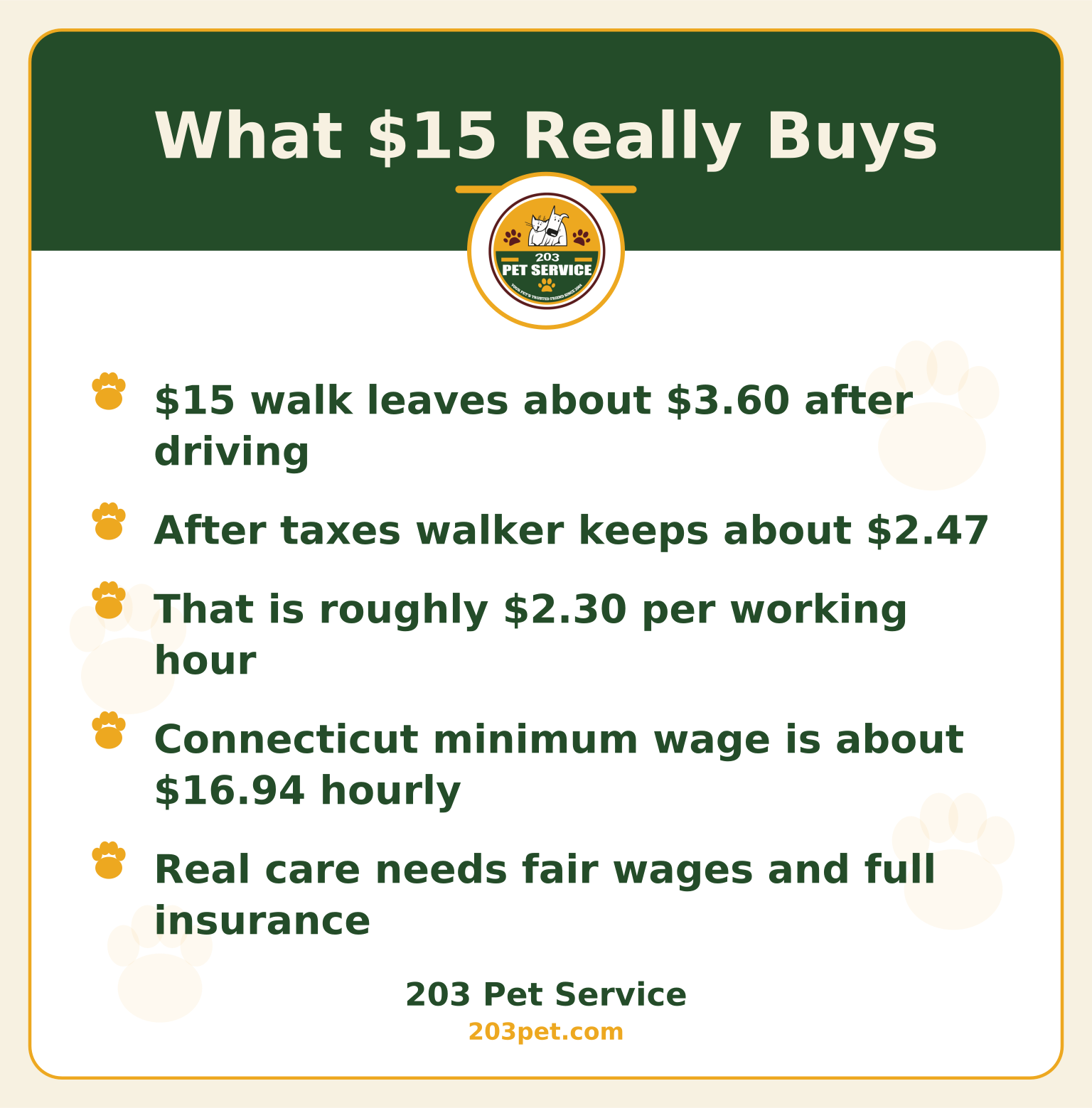
The walker drives to your home. Say it is 15 miles round trip. That is normal even inside a single town. The government business mileage rate for 2026 is about 76 cents a mile, which is what it really costs to run a car once you count gas, insurance, tires, brakes, and wear. 15 miles times 76 cents is about $11.40. So before anything else, that $15 walk is down to about $3.60.
Now the taxes. An independent walker is a contractor, so they cover both halves of Social Security and Medicare plus federal and state income tax, which lands around 31%. Take that off the $3.60 and the walker is left with about $2.47.
How long did this take? About 30 minutes with your dog, plus the drive, so roughly an hour in all. That means the person caring for your dog just earned about $2.30 an hour. Connecticut minimum wage in 2026 is about $16.94 an hour. This person is making roughly one seventh of that, to care for an animal you love.
The chart nobody wants you to see
Here is how the math changes as the price goes up. Same honest method every time. Subtract the driving, subtract the taxes, then divide by the hour it really takes.
| You are charged | After driving | After taxes | Real per hour |
|---|---|---|---|
| $15 | about $3.60 | about $2.47 | about $2.30 |
| $20 | about $8.60 | about $5.91 | about $5.55 |
| $25 | about $13.60 | about $9.34 | about $8.75 |
| $30 | about $18.60 | about $12.78 | about $12.00 |
| $35 | about $23.60 | about $16.21 | about $15.20 |
| $40 | about $28.60 | about $19.65 | about $18.40 |
| $45 | about $33.60 | about $23.18 | about $21.75 |
| $50 | about $38.60 | about $26.63 | about $25.00 |
| $55 | about $43.60 | about $30.08 | about $28.20 |
| $60 | about $48.60 | about $33.53 | about $31.45 |
To be clear, we are not saying a half hour walk should cost $60, and we do not charge that. The chart goes that high to show one honest truth: the walker does not even earn a real living wage until you are well past the discount rates. That is exactly the range where corners stop getting cut. Look at where the walker finally clears today's Connecticut minimum wage. It is not at $15, and not at $25. The person walking your dog does not earn a legal minimum wage until you are paying somewhere around $40 a walk. So honest, insured care lands in the fair middle of that chart, not the bottom and not the top.
What about Rover or Wag?
📺 Walk & Train Program, 203 Pet Service
Maybe the walker found you through one of the big apps. The short version is that those apps take a cut from the walker and then add a fee on top of your price, so a "$25 walk" can cost you almost $28 while the walker still ends up around $2 an hour. The app keeps the difference and never touches your dog. We broke down exactly how that works in a separate article: how Rover and Wag take their cut while you take the risk.
What you are really paying for with 203 Pet Service

Here is the honest flip side. When you hire a real, insured business, the higher price is not markup. It is the safety net that protects you, your dog, and your home.
You are paying for real employees, not gig workers. Every member of our team is a W-2 salaried employee, which means we pay payroll taxes, carry workers' compensation, and stand behind their work. That is the difference between a real business and an envelope of cash. It is also what keeps good people around long enough to actually know your dog.

You are paying for people we vet harder than you ever could on your own. Before anyone on our team meets you, they have already passed a full reference check, a background check, and a drug test. A proper background check and drug screening can take over a week to come back, and we wait for it every time. Think about why that matters: a dog walker has unsupervised access to your home. The right way to make that safe is not to hope for the best at $2 an hour. It is a real company that checks its people, trains them, and is accountable for them.
You are paying for real insurance. 203 Pet Service carries liability insurance and workers' compensation. That protects you in a way people rarely think about. If an uninsured walker slips on your steps, or your dog pulls hard and they fall and get hurt on your property, they can come after your homeowners policy. With a fully insured company, your home and your policy stay out of it. You would not want an uninsured stranger up on your roof. Your dog deserves the same standard at your front door.

You are paying for backup and for reviews you can actually trust. If your regular walker is sick, your dog still gets cared for that day. And our reviews are out in the open on Google and Facebook, every client free to say what they want. That is the opposite of three hand picked phone numbers from a solo walker.
You are also paying for a company that actually knows this area. We are local, and every week we care for dogs across Fairfield, Southport, Black Rock, Stratford, Bridgeport, Westport, and Easton. That local footprint is a big part of how we cover for each other. When your regular walker is out sick, someone nearby already knows your neighborhood, your street, and your dog.
The story that stays with me

I have been doing this a long time, and some calls you never forget. One family came to me after their previous puppy got away from a walker and was never found. Their two young children were devastated. They came to me because they wanted an established, insured, local company they could actually trust, and to never gamble on the wrong person again. No walk is cheap enough to be worth that risk.
The last minute trap

Here is how this usually goes wrong. Someone needs a walker for tomorrow, so they grab the cheapest name they can find and book it fast. Doing it right takes real time, and that time is the whole point. A proper meet and greet before anyone gets your key takes time. Checking references takes even more, because you have to track down each one and actually call them, which can eat up an hour or more of your evening.
So ask what your time is worth. The median household in the town of Fairfield earns well over $148,000 a year, which works out to about $77 an hour, and plenty of homeowners here are worth $100 an hour or more. Now watch what happens to that "cheap" walk. The walk is $15. Vetting it the right way costs you an hour or more, which is roughly $100 of your time. Your $15 walk just quietly became a $115 walk. And that is more than 203 Pet Service would have charged, except we would have handled all the vetting for you.
There is one more catch. At $2 an hour, cheap walkers quit. When they do, you are right back at the start, doing the whole vetting dance over again, another hour gone, another $115 walk just to replace the last one. At that point you are not saving money. You are paying over and over for the privilege of doing it yourself.
Five questions to ask before you hire a dog walker

- Are you insured, do you carry workers' compensation, and can you show me proof? A real business says yes without hesitating and shows you the paperwork. If someone dodges this, stop there.
- Who exactly will be coming to my home, and will I meet them first? You should always meet your walker before anyone holds your key.
- What happens if my regular walker is sick or on vacation? A real business has a backup plan. A single person working alone usually does not.
- How do you handle an emergency with my dog? Listen for a real, specific answer, not a vague "I would figure it out."
- Can I talk to other local families you care for? Real businesses have real clients who will vouch for them, and open reviews you can read yourself.
If someone dodges these questions, or gets offended that you asked, you have your answer.
A $15 walk is not a bargain. It is a warning sign.

It means someone is either not counting the real costs, or is about to disappear on you, or is being squeezed so hard that your dog and your home are the ones at risk. You love your dog like family. You proved that the day you brought them home. So when it comes to who cares for them, and who holds the key to your house, do not shop for the cheapest. Shop for the one you can trust.
Ready to meet a walker you can actually trust? Reach out and set up a meet and greet. No pressure, just a conversation about what your dog needs and how we can help.
Frequently asked questions

Is a $15 dog walk safe?
Usually not. At $15, after driving and taxes the walker keeps only about $2, which almost never buys real insurance, real vetting, or someone who sticks around. The low price is a warning sign, not a deal.
How much should a dog walk cost in the town of Fairfield?
More than the discount rates you see advertised. A walker does not even clear Connecticut minimum wage until you are paying around $40 a walk, and honest, insured care lands in a fair middle range above that. You are paying for insurance, vetting, backup coverage, and people who stay.
Are Rover and Wag cheaper?
Not really. Both take a cut from the walker and add a fee on top of your price, so a "$25 walk" can cost you almost $28 while the walker still ends up at about $2 an hour. The app keeps the difference and never touches your dog.
What does insurance actually cover, and why does it matter to me?
If an uninsured walker gets hurt on your property, they can come after your homeowners policy. A real, insured company carries liability and workers' compensation insurance, so your home and your policy stay protected if anything goes wrong.
Why does 203 Pet Service use salaried W-2 employees instead of independent contractors?
Salaried W-2 employees are more reliable, accountable, and professional. They go through careful background checks, full training, and are fully insured, which means consistency and peace of mind for Fairfield County families.